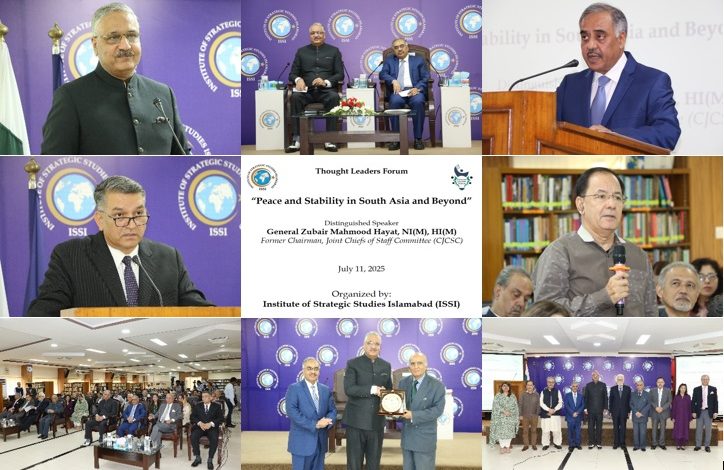
In an insightful address at the Institute of Strategic Studies Islamabad (ISSI), former Chairman Joint Chiefs of Staff Committee General Zubair Mahmood Hayat shared a strategic overview, warning that South Asia remains dangerously close to instability following recent regional crises. Stressing that sustainable peace can only arise from justice, trust, and mutual respect, General Hayat cautioned about the growing risks of conflict escalation due to India’s aggressive policies, military build-up, and evolving strategic ambitions.
Ambassador Sohail Mahmood, in his introductory remarks, set the context by highlighting rapid transformations shaping global affairs, especially intensifying great-power rivalries, militarisation trends, declining multilateralism, and rising non-traditional security threats. He reviewed the severe security crisis in South Asia triggered by India’s groundless allegations against Pakistan, following a terrorist attack in Indian Illegally Occupied Jammu & Kashmir (IIOJK). Ambassador Mahmood emphasised that the volatile situation in May nearly led to a full-scale war, yet Pakistan’s measured, firm, and diplomatic response helped defuse tensions. He further underscored the critical importance of maintaining crisis communication channels, ceasefire stabilisation, and sincere dispute-resolution efforts, particularly regarding Jammu and Kashmir. Describing broader regional challenges including halted South Asian Association for Regional Cooperation (SAARC) engagements and increasing securitisation, Ambassador Mahmood reiterated that Pakistan must sustain strong defence preparedness and proactive diplomacy for regional stability.
In his keynote speech, General Zubair Mahmood Hayat expressed serious concern regarding South Asia’s increasingly fragile security environment, describing it as a complicated quagmire characterised by weak crisis-management mechanisms, absent regional security frameworks, and insufficient meaningful dialogue. He emphasised that genuine peace cannot be externally imposed or purchased, but must be earned through mutual trust, justice, and sovereign equality among regional states.
General Hayat vividly captured the severity of the security dilemma, noting metaphorically that South Asia’s “doomsday clock” stands critically at “30 seconds to midnight.” He specifically highlighted India’s role, driven increasingly by ideological motivations and aggressive military policies under the shift from the “Doval Doctrine” to the “Modi Doctrine,” which he said has instigated a policy of “reverse deterrence”—reinforcing rather than weakening Pakistan’s resolve. Historically recognised as a nuclear flashpoint, the Kashmir issue gained additional complexity during the recent crisis, with water disputes emerging as another potential trigger for regional conflict.
Urging immediate action, General Hayat called on Pakistan’s leadership to seize this juncture as an opportunity for internal reform, contingency preparations against evolving threats, and strategic positioning to tap into emerging global opportunities. He emphasised clarity, vigilance, and resilience in policymaking to proactively steer the nation through turbulent regional and international waters.
Following General Hayat’s thought-provoking address, attendees engaged in a lively and meaningful question-and-answer session. Participants discussed various dimensions of South Asia’s strategic dynamics, benefiting significantly from General Hayat’s strategic insights and perspectives.
Earlier, in his remarks, ISSI Director Dr. Talat Shabbir had welcomed guests and underscored peace and stability’s critical importance amidst South Asia’s strained security architecture, confronting both traditional and non-traditional threats.
At the conclusion, Ambassador Khalid Mahmood, Chairman of ISSI’s Board of Governors, presented a memento to General Zubair Mahmood Hayat, expressing the Institute’s gratitude. The event drew diplomats, scholars, and regional experts for engaging discussions about stabilising South Asia and charting pathways for enduring peace across the broader region.