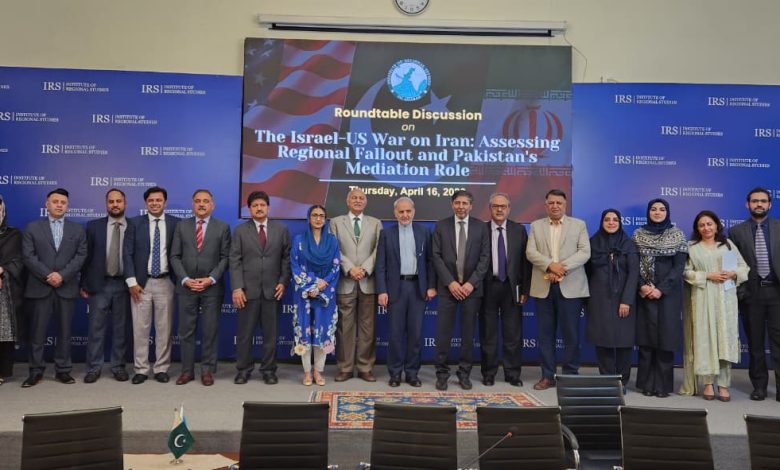
The Institute of Regional Studies in Islamabad convened a high-level roundtable to examine the regional fallout of the 40-day US–Israel campaign against Iran and to assess Pakistan’s evolving role as mediator. The discussion brought together Iran’s Ambassador to Pakistan Dr. Reza Amiri Moghadam, Senator Mushahid Hussain Sayed, Ambassador Asif Durrani, Maj. Gen. (r) Zahid Mahmood, journalist Hamid Mir and media analyst Muneezay Jehangir, and was chaired by Institute President Ambassador Jauhar Saleem.
Ambassador Saleem cautioned about the broad economic and strategic consequences of the conflict, citing surging energy prices, trade disruptions and the real threat of wider regional escalation. He credited Pakistan’s diplomatic engagement with helping to draw Iran and the United States back from the brink of uncontrolled confrontation, noting that Pakistan mediation is now viewed as an important diplomatic channel by key stakeholders.
In a keynote address Senator Mushahid Hussain described the moment as pivotal in Pakistan’s diplomatic history, drawing parallels with Pakistan’s facilitation of the Beijing–Washington backchannel in the 1970s. He outlined three structural consequences of the conflict: the weakening of the “Greater Israel” concept, an erosion of US influence in the region, and the pressing need for a new cooperative security architecture. He stressed that “the security of the Gulf must be determined by regional stakeholders, not external powers,” underscoring why Pakistan mediation carries regional significance.
Ambassador Dr. Reza Amiri Moghadam offered an on-the-ground perspective, expressing appreciation for Pakistan’s support and cautious optimism about the Islamabad Talks. He reaffirmed Iran’s readiness for dialogue while warning that external adversaries seek to destabilize the state, and he emphasized Iran’s institutional resilience. He identified Pakistan as a trusted neighbour and preferred interlocutor for constructive diplomacy.
Ambassador Asif Durrani argued that the objectives claimed by US and Israeli action had not been met and called for a new regional security framework supported by Russia and China to secure long-term stability. Maj. Gen. (r) Zahid Mahmood framed the crisis within a broader shift toward multipolarity, noting increased incentives for regional nuclear deterrence and new risks of horizontal escalation that carry implications for Pakistan’s own security posture.
Senior journalist Hamid Mir observed that Iran’s resilience during the conflict has enhanced Pakistan’s stature as a mediator and weakened perceptions of US global dominance, creating pressure for renewed negotiations. Media analyst Muneezay Jehangir highlighted Pakistan’s consistent advocacy for dialogue and noted that public opinion in both the United States and Pakistan remains broadly opposed to prolonged conflict, reinforcing the urgency of diplomatic engagement.
The roundtable concluded with a clear consensus that Pakistan mediation presents both strategic opportunity and heavy responsibility. Participants urged a forward-looking diplomatic approach that strengthens regional security architecture, keeps channels of communication open and limits the spillover risks for Pakistan and its neighbours.