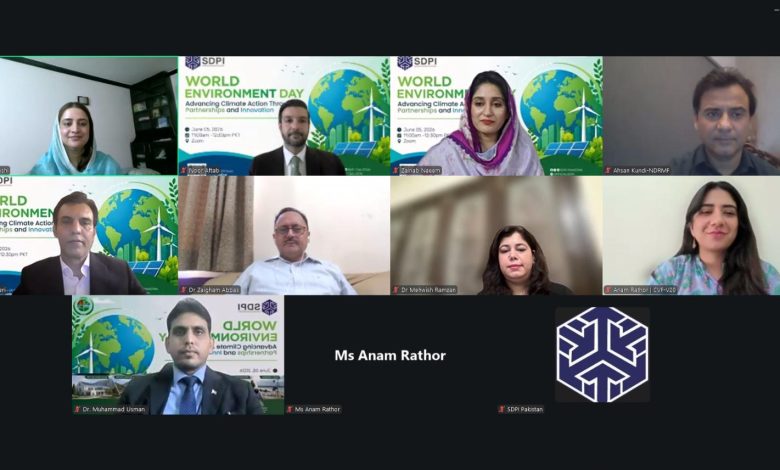
Experts at a webinar hosted by the Sustainable Development Policy Institute on World Environment Day urged integrating climate action into development planning, budgeting and policymaking to build resilience against rising climate risks in Pakistan.
Dr. Abid Qaiyum Suleri, SDPI executive director and chairman of the National Disaster Risk Management Fund board, called for evidence-based policymaking, innovative financing and stronger institutional partnerships so that climate resilience becomes a central pillar of national development and budget priorities align with local implementation.
Dr. Suleri framed climate adaptation as an economic investment that protects livelihoods, infrastructure and future growth and urged scaling up climate finance, improving coordination between federal and provincial bodies, and keeping vulnerable communities at the centre of action. He highlighted the role of research and policy institutions in supporting informed decision-making and multi-stakeholder collaboration.
Syed Abrar Hussein of the Pakistan Environmental Protection Agency highlighted practical measures including converting confiscated single-use plastics into benches, planters and waste bins for schools and public spaces, the conversion of 33 traditional brick kilns in Islamabad to zigzag technology to cut emissions, and installation of bag-filter systems in cooperation with the steel industry to capture emissions and recover zinc. He stressed that policies must reach farmers through awareness, training and climate-smart agriculture and water conservation.
Dr. Shafqat Munir of SDPI warned that climate change is a present development reality affecting food and water security, public health and social cohesion and urged a shift from fragmented responses to anticipatory action and risk-informed development. Dr. Muhammad Usman of NDMA described enhancements to the National Emergency Operations Centre, impact-based forecasting and multi-channel early warning dissemination as steps toward better community preparedness and recommended integrating climate resilience standards into infrastructure planning.
Speakers flagged financing gaps and the need to convert commitments into bankable projects. Sohail Maqbool Malik of the Climate Resourcing Coordination Centre urged development of an investment-ready project pipeline. Anam Rathore from the Climate Vulnerable Forum and V20 called for fairer international access to adaptation and loss-and-damage finance. Ahsan Kundi of NDRMF outlined work on a Disaster Risk Financing Strategy Framework and urged public-private collaboration to ensure funds are available before disasters strike.
Private sector contributors stressed practical measures to support climate goals. Noor Aftab of Tetra Pak pushed for a circular economy, design for recyclability and a standardized national Extended Producer Responsibility framework. Dr. Mehwish Ramzan of Jazz highlighted the importance of ESG governance and private investment to accelerate Pakistan’s transition to a low-carbon, resilient economy. The discussion was moderated by Saleha Qureshi of SDPI.
Speakers agreed that aligning science, policy, finance and community action is essential to turn climate action into a sustainable development pathway for Pakistan, with strengthened disaster preparedness, innovative financing and inclusive local implementation at the heart of progress.