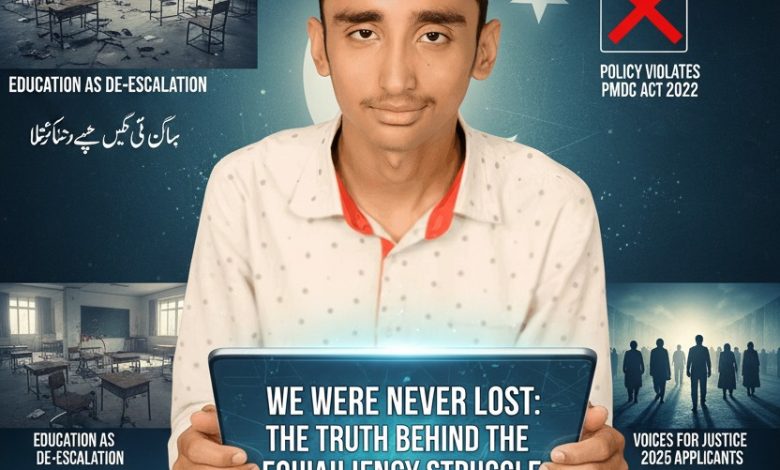
We Were Never Lost: The Truth Behind the Equivalency Struggle
By Muhammad Abdullah Osaid
For months, a misleading narrative has circulated suggesting that the struggle for relative marking and equivalency somehow failed or lost direction. That narrative is false. We were never lost. What truly happened must be documented—clearly, responsibly, and without distortion.
A Reform Oriented Committee from Day One
The National Assembly Standing Committee on National Health Services & Coordination (NHSR&C), under the chairmanship of Dr. Mahesh Kumar Milani, has consistently remained a reform-driven body with health-sector transformation at the core of its agenda.
From the outset, the committee was willing, motivated, and serious about implementing a fair and legally defensible system of relative marking/equivalency. There was no lack of intent at the parliamentary level.
So the real question remains:
If the Committee Was Willing, Why Did the Tables Turn?
Until recently, the complete answer was known only to Sardar Umar and myself. Now, it must be shared publicly.
The core issue was never the absence of a globally recognized or legally defensible formula. Such formulas exist internationally and have been successfully implemented in the past—including in Pakistan, where the former PMC applied similar models to ensure fairness.
To address the issue, PMDC consulted leading institutions such as NUST, UET, and NTS to derive or adapt an equivalency mechanism. Despite the availability of proven, legally sound models, PMDC failed to understand, adapt, or implement them—even for massive cohorts like Punjab’s nearly 50,000 candidates.
Instead, PMDC insisted on creating a new formula from scratch, a process they repeatedly failed to complete.
When Pressure Reached Its Peak
At one critical moment, the pressure was undeniable.
One morning, a senior official (name withheld) contacted me directly and asked:
“Do you have any formula that can be implemented legally and practically?”
Together with Sardar Umar, we immediately shared the simplest, most feasible, and legally sound formula. We conducted long online sessions, explained every technical and legal aspect, and extended full cooperation.
Yet nothing moved forward.
As the saying goes:
“جتھے دی کھوتی اتھے اڑھ کھلوتی”
Institutional Incompetence Beyond Explanation
Despite months of engagement, PMDC failed to finalize or implement any formula. More alarmingly, instead of exercising its statutory authority, it delegated its core powers to the conducting university, under pressure a move that directly violated the PMDC Act 2022.
This was not a technical lapse; it was an institutional failure.
PM&DC’s High Level Council Meeting: Acknowledging the Crisis
On 18 November 2025, taking serious notice of widespread media reports and the immense stress faced by students, the Pakistan Medical & Dental Council (PM&DC) convened a high-level council meeting at its headquarters to address concerns related to the 2025–26 admission policy.
The meeting included:
PM&DC Council members
Vice Chancellors
BCC representatives
Legal experts
Importantly, Dr. Mahesh Kumar Milani attended as a special invitee, reaffirming parliamentary oversight and concern.
PM&DC publicly stated that the sole purpose of the meeting was to ensure that no stone is left unturned in identifying solutions that provide maximum relief, clarity, and facilitation to students.
The council emphasized that it considers every student part of its own family and committed to providing complete cooperation across all platforms during this critical stage of students’ academic journeys.
Legal Reality Acknowledged But No Solution Delivered
PM&DC council members clarified that while the three-year validity of the MDCAT result is clearly defined by law—a matter falling under Parliament—the council would always safeguard students’ interests.
However, during court proceedings, authorities themselves admitted:
“We held many meetings but failed to devise a solution, and instead proposed restricting validity to one year through future legislation.”
This admission alone explains why the courts repeatedly stated that policy formulation is not a judicial function, particularly in specialized educational matters.
Let There Be Absolute Clarity
Our struggle was never against 2024-based applicants. They were neither respondents nor adversaries. They were merely impleaded audiences—used by PMDC as a shield to conceal its own incompetence.
Voices That Still Stood for Justice
Despite systemic failure, many stood with us until the very end.
Dr. Mahesh Kumar Milani stated unequivocally:
“We agree this is injustice, but the entire system is politically integrated. Even if one stakeholder agrees, another openly opposes due to political conflict.”
Responsibility also lies with Dr. Mustafa Kamala, identified as a central figure in obstructing progress.
Even the opposition admitted:
“Yes, this policy is wrong—but we have no solution.”
That admission itself is a victory.
Our Final Conclusion
The real winners will be the 2025-based applicants.
Our stance remains firm:
We stand against injustice every time regardless of outcome.