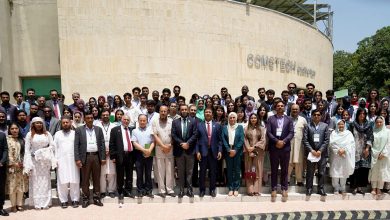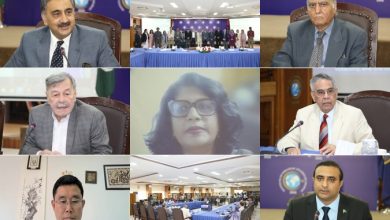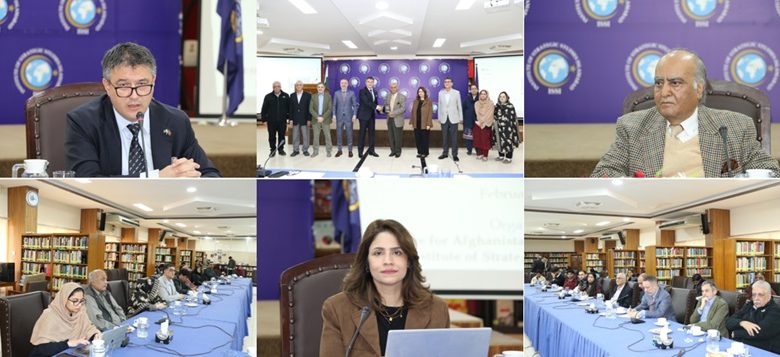
The Institute of Strategic Studies Islamabad’s Centre for Afghanistan, Middle East and Africa hosted a Distinguished Lecture featuring Dr. Flavius Caba Maria, president of Romania’s Middle East Political and Economic Institute, with opening remarks by Dr. Amina Khan, director of CAMEA, and comments from Ambassador Khalid Mahmood, chairman of the ISSI board of governors.
Dr. Amina Khan described three interlinked priorities shaping EU policy in the region: deeper engagement with the Gulf, shifting dynamics of the Israel–Palestine conflict amid the ongoing Gaza war, and diplomatic management of relations with Iran. She noted that the prolonged Gaza conflict has altered public opinion across Europe, raising pressure on policymakers to weigh humanitarian concerns while balancing other strategic interests. Iran, she added, remains central to the EU Middle East agenda because of nuclear proliferation risks and broader regional stability considerations.
Dr. Flavius argued that the EU’s approach to the region is cautious, legally anchored and internally fragmented, responding to changing geopolitical realities. On Gaza, he said European responses have largely reinforced existing international frameworks, welcomed UN Security Council Resolution 2803 and stressed that initiatives such as the Board of Peace must operate within a UN-led structure. He reaffirmed the EU commitment to international law and the two-state solution, warned about developments in the West Bank that could undermine viability, and noted continued support among most states for a pre-1967 line framework alongside renewed discussions about alternative political models.
Turning to the Gulf, Dr. Flavius highlighted the rising strategic importance of EU–GCC cooperation following the October 2024 EU–GCC summit and under the Joint Action Programme 2022–2027. He pointed to trade corridors, technological exchange and sustainable energy as core pillars of Europe’s effort to diversify partnerships and enhance resource independence.
On Iran, he described relations at a historic low after the EU’s designation of the IRGC as a terrorist organization, a development that has narrowed diplomatic channels and could marginalize European involvement in potential U.S.–Iran negotiations. He warned that such moves complicate prospects for the JCPOA and broader nuclear discussions, and that internal EU divisions, dependence on the American security architecture and the waning mediator role of the E3 since 2018 have constrained Europe’s leverage as Iran deepens ties with eastern partners.
Addressing Syria, Dr. Flavius observed a recalibration in EU policy driven by security and migration concerns, marked by selective engagement, enhanced counterterrorism coordination and substantial financial commitments for stabilization and humanitarian relief.
Ambassador Khalid Mahmood reflected on the persistent tension in European policy between stated values—human rights, humanitarian principles and international law—and strategic imperatives tied to regional stability. He noted ongoing European diplomatic engagement across Lebanon and Syria, continued humanitarian support for Gaza, and reaffirmed the EU’s stated backing for a two-state solution while underscoring the pragmatic trade-offs policymakers face.
The event drew diplomats, academics, students, practitioners and civil society representatives and concluded with an extended question and answer session. For Pakistan, evolving EU Middle East policy carries implications for energy and trade linkages, migration flows and diplomatic alignments, underscoring the need for Islamabad to monitor EU–Gulf relations and European approaches to Iran and the Israel–Palestine crisis.