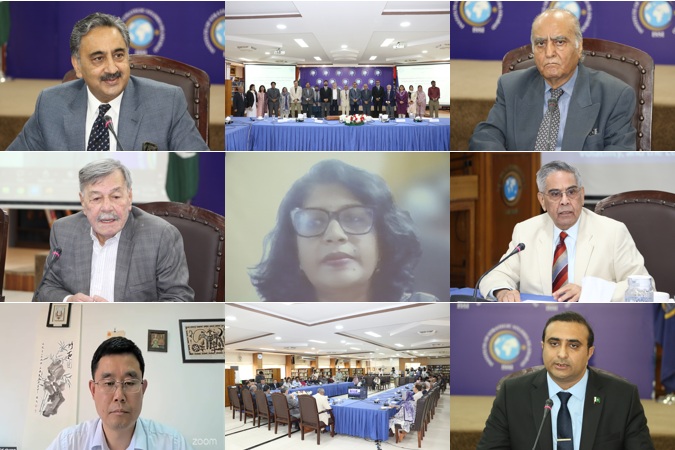
On 10 June 2026 the India Study Centre at the Institute of Strategic Studies Islamabad convened a high-level roundtable addressing the legal and strategic risks to the Indus Waters Treaty. The event brought together regional and international experts to examine India’s recent unilateral stance and its implications for downstream states, Pakistan’s rights, and regional stability.
Ahmer Bilal Soofi, former federal minister for law and human rights, serving as guest of honour, reminded attendees that Article 12(4) of the Indus Waters Treaty allows modification only by mutual consent and that the treaty cannot be unilaterally abrogated or legally suspended. He noted that statements by India’s leadership since 2014 signalled intent to alter the treaty framework and that the declaration of the treaty being placed in abeyance in 2025 followed a pattern of political decisions rather than lawful procedure. Mr Soofi warned that such moves threaten lower riparian states, including Bangladesh, and reflect broader regional ambitions that could destabilise cooperative water governance.
In welcome remarks, Ambassador Khalid Mahmood, chairman of ISSI’s Board of Governors, emphasised that South Asia is among the most water stressed regions globally and that political manoeuvring over water undermines peace and development. He underlined that the Indus Waters Treaty is an international legal instrument without provisions for unilateral suspension and urged India to rescind its stance while affirming Pakistan’s commitment to lawful, institutional dispute resolution and protection of treaty rights.
Dr Khurram Abbas, director of the India Study Centre, traced the rapid changes since April 2025 when the treaty’s future began to be questioned. He said India fast-tracked multiple hydropower projects following its abeyance declaration, citing investments exceeding 41,000 crore Indian rupees and accelerated construction on controversial schemes, raising urgent concerns about downstream flows and the treaty’s institutional resilience.
Dr Sofia Khanom of the Bangladesh Institute of International and Strategic Studies described Bangladesh as water stressed outside the monsoon season, vulnerable to climate impacts and saline intrusion. She warned that up to 20 percent of the country could be submerged by 2050, that a large share of the population lacks safe water, and that heavy reliance on groundwater is causing alarming depletion. Dr Khanom argued for institution-based water diplomacy while noting reluctance among some Global South actors to accept external mediation.
Ambassador Shafqat Kakakhel recalled the nine-year negotiation that produced the Indus Waters Treaty and said Article 9 provides a clear dispute settlement path. He argued that protecting the treaty is not solely Pakistan’s interest but critical for all lower riparian countries and for upholding the model of transboundary cooperation the treaty once represented.
Dr Zhang Jiadong of Fudan University provided historical context, noting how post-Partition river diversions prompted World Bank mediation from 1954 to 1960 and ultimately the 1960 treaty with its multilevel conflict resolution architecture. He cautioned that the 2025 declaration of abeyance has systematically eroded that architecture and called for international responsibility to protect the rights and institutional resilience of vulnerable downstream parties.
Ali Tauqeer Shaikh drew attention to Pakistan’s technical and diplomatic posture, observing that engineers have often led treaty engagement when high-level negotiation was needed. He noted early signs of Indian intent were overlooked and recommended leveraging satellite data and independent monitoring so Pakistan need not rely on counterpart cooperation for information on river projects and flows.
The discussions underscored the legal firmness of the Indus Waters Treaty, the strategic risks from unilateral actions, and the pressing need for strengthened institutional mechanisms and regional dialogue to safeguard water security. The session concluded with a question-and-answer exchange attended by diplomats, academics, policymakers and students, who stressed continued vigilance and diplomatic engagement to defend Pakistan’s treaty entitlements and regional stability.