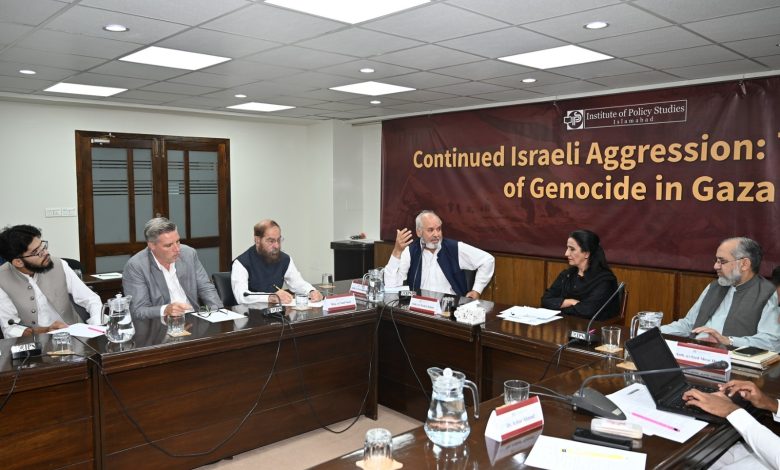
Senior diplomats, defence experts and analysts at an Institute of Policy Studies seminar in Islamabad warned that the Gaza crisis exposes a wider breakdown in international responsibility and the impotence of many global institutions. Speakers argued that the ongoing Israeli actions and mass civilian suffering underline the urgent need for a coordinated Muslim response built on shared resources, joint defence arrangements and deployable peacekeeping forces.
Naila Chauhan, the keynote speaker and former ambassador, stressed the importance of presenting the Palestine issue accurately so policy responses are grounded in a clear understanding of the conflict’s drivers. She cautioned against reducing the crisis to only religious or political terms, noting that commercial interests in land and development have also fuelled attempts to displace Palestinians from Gaza.
Nasrullah Khan described the scale of abuses faced by Palestinians as beyond adequate expression and said the October 7 events only intensified a tragedy that predated that date. He framed the Gaza crisis as evidence of the international community’s collective failure to protect civilians and uphold fundamental norms.
Brigadier (R) Syed Nazir criticised continued Western backing for Israel and the reluctance of international bodies to enforce resolutions, saying such dynamics have enabled the persistence of aggression. He added that tepid responses from many Arab states have further emboldened actions on the ground and weakened regional deterrence.
Dr Azhar Ahmed argued for moving beyond narrative summaries to rigorous verification of Israeli claims and practical evaluation of global responses. He urged analysts and policymakers to scrutinise the effectiveness of measures that could prevent further mass atrocities and to develop strategies to halt ongoing violence in Gaza.
The seminar also flagged geopolitical developments that undermine peacemaking, including attacks that targeted negotiating teams and actions that have eroded the credibility of security guarantees. Speakers pointed to the recently announced Pakistan-Saudi strategic defence framework as a model that could underpin a broader security architecture among Muslim states capable of deterring expansionist plans.
In closing remarks, former ambassador and IPS vice chairman Syed Abrar Hussain said the international sympathy for Palestinians has revived debate over a two-state solution and encouraged recognition moves, but diplomatic obstacles remain as vetoes stall ceasefire initiatives. He proposed that deploying Muslim-led peacekeeping contingents to Gaza and coordinating military, economic and technical capabilities among friendly states could create conditions for sustained protection of civilians and a return to credible negotiations.