Federal Minister for IT & Telecom Shaza Fatima Khawaja addressed students and faculty at FAST National University Islamabad on government efforts to secure the country’s digital frontier. Speaking at an event hosted by the FAST Public Policy and Research Society, she welcomed collaboration between government, academia and youth as central to Pakistan’s cyber resilience and stressed that Cybersecurity Pakistan is now a national priority.
The minister referenced Pakistan’s Tier‑1 ranking in the ITU Global Cybersecurity Index as evidence of a strengthened national posture and outlined the whole‑of‑nation approach driving reforms. She described how the National Cybersecurity Policy 2021, the upcoming Cybersecurity Act 2025 and the Digital Nation Act together form the backbone of policy action to protect critical infrastructure and citizen data as Cybersecurity Pakistan advances.
Under the planned Cybersecurity Act, a National Cybersecurity Authority will be established to coordinate incident response and threat intelligence nationwide, while expansion of PkCERT and secure digital public infrastructure under the DEEP project will bolster operational readiness. The minister credited the leadership of the Prime Minister, the Field Marshal, the Cabinet and SIFC for embedding AI and technological transformation into national security plans and policy, further strengthening Cybersecurity Pakistan.
Recalling the recent Marka‑e‑Haq period, the minister said coordinated cyber defence demonstrated Pakistan’s ability to respond effectively in the modern digital battlefield. She noted this episode showed the cyber domain functions as a frontline of defence and that Pakistan’s integrated response reflected both institutional resilience and technical capability.
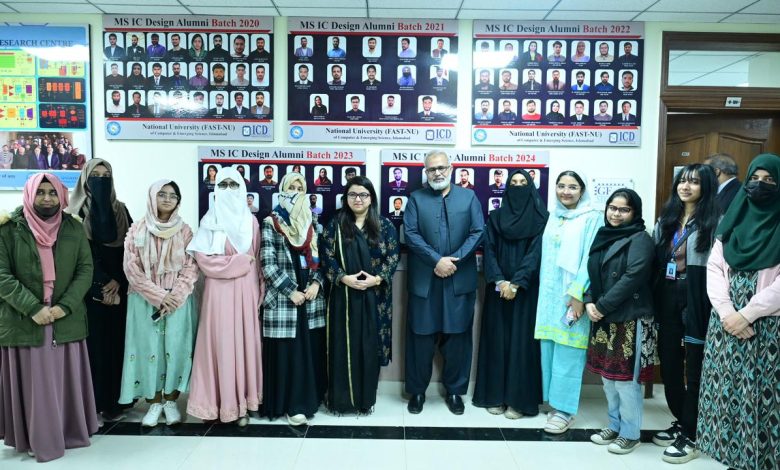
During her visit the minister toured FAST‑NU Islamabad’s IC Design Lab and met participants of Ignite’s flagship Training in IC Design & Verification. She praised the hands‑on program run by FAST‑NU that trains 30 young engineers, including seven women, in a rigorous 10‑month curriculum equivalent to a postgraduate diploma; successful participants may pursue an MS with an additional six credit hours. The minister highlighted how such initiatives feed national talent pipelines needed for semiconductor design and secure hardware development within Cybersecurity Pakistan efforts.
Minister Shaza Fatima also outlined priorities for an AI‑driven cyber strategy that includes dark‑web monitoring, cloud security under the Cloud‑First Policy and secure identity frameworks. She emphasised that public‑private cooperation remains essential, citing the Digital Pakistan Cybersecurity Hackathon as a source of talent now competing on global stages such as Black Hat MEA, all contributing to the wider goals of Cybersecurity Pakistan.
As Pakistan moves to institutionalise the Cybersecurity Act and scale capacity through PkCERT, DEEP and targeted training programs, the minister said the country is positioning itself to combine secure infrastructure, technological excellence and human capital development in pursuit of a resilient digital nation.