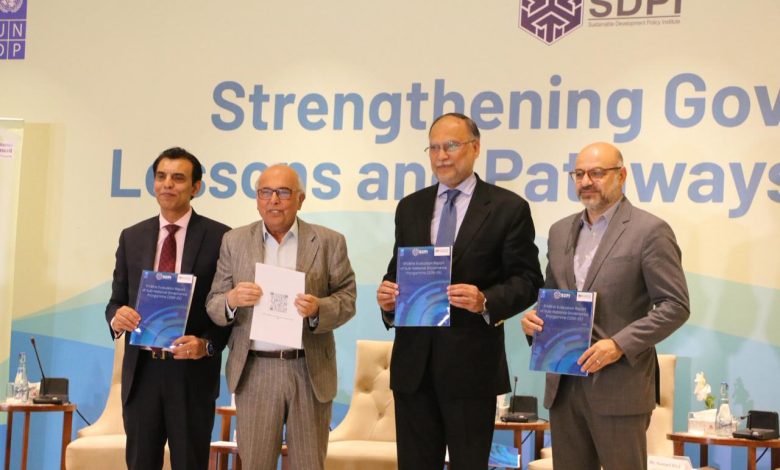
Prof. Ahsan Iqbal told a high-level UNDP–SDPI dialogue that governance is the face of the state citizens meet every day and that governance reform must reach federal, provincial, district and grassroots levels to deliver real change.
Addressing the SNG-II evaluation event, the federal minister stressed that converting evidence into action is essential because governance often determines whether plans advance or remain dormant. He urged stakeholders to focus on practical reforms that improve service delivery in areas such as education, health and roads, saying stability and strong governance are the runway for Pakistan’s economic take-off under the URAAN Pakistan agenda.
The minister noted that the Eighteenth Amendment was a landmark step that devolved powers to provinces but left devolution incomplete at district and local levels. He argued that provincial capitals alone cannot solve the problems of remote districts and towns, and called for governance reform that strengthens local governments, prioritizes measurable outcomes over mere expenditure utilization and improves public finance transparency and resource mobilization.
The independent evaluation by SDPI documented concrete gains from the SNG-II programme in Punjab and Khyber Pakhtunkhwa, including stronger planning systems, digitization of PC-1 workflows, improved audit mechanisms, pension reforms and integrated budgeting processes. Innovations such as GIS-based mapping and local government financial reporting have helped boost transparency and administrative efficiency, showing how governance reform can produce tangible results.
SDPI presenters highlighted practical steps to sustain reforms, including retaining technical expertise at district level, securing statutory backing through administrative notifications, and coordinating with provincial IT boards to maintain digital initiatives. The evaluation also recommended institutionalizing gender and climate budget tagging, strengthening internal audit functions and expanding peer-to-peer learning between districts to lock in long-term benefits.
Speakers from UNDP and the FCDO underlined the need to strengthen ownership of governance reform after SNG-II, integrate governance priorities into budgeting and national planning, and build resilient local institutions that can withstand fiscal and political shocks. The partnership model that supported embedded technical assistance and reform working groups was credited with keeping momentum despite transitions.
All participants agreed that reforms cannot be delivered by government alone and that think tanks, development partners and civil society must work in concert to turn potential into performance. The SNG-II experience offers a practical road map for the next generation of governance reform focused on provincial and grassroots systems that deliver results for ordinary citizens.