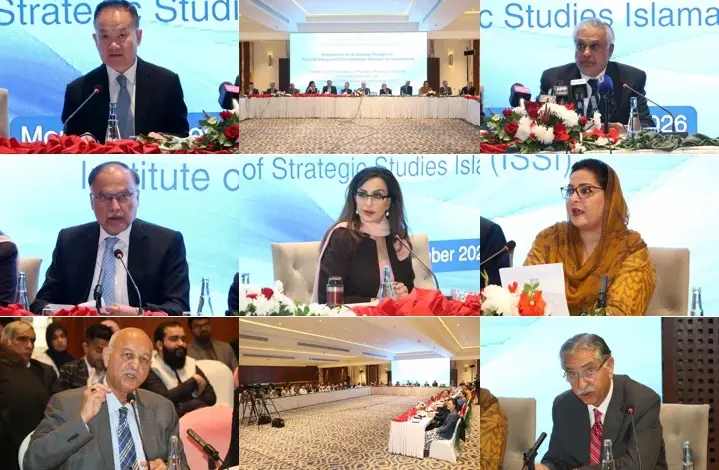
ISLAMABAD: Deputy Prime Minister and Foreign Minister Senator Mohammad Ishaq Dar has said that Pakistan-China relations draw strength not only from intergovernmental cooperation but also from sustained political understanding, institutional linkages and exchanges between political parties.
“Our engagement underscores an important dimension of the Pakistan-China relationship, and that is the strength rests not only on intergovernmental cooperation, but also on sustained political understanding, institutional linkages and exchanges between our political parties,” he said.
Senator Dar made the remarks while co-chairing the “Symposium on Xi Jinping Thought on Party Building and Seminar on China-Pakistan Governance” with Mr Liu Haixing, Minister of the International Department of the CPC Central Committee (IDCPC), in Islamabad. The event was jointly organised by the Embassy of the People’s Republic of China and the Institute of Strategic Studies Islamabad (ISSI) at the Marriott Hotel.
Addressing the symposium, Senator Dar underlined the importance of political parties in governance, institution-building and national development. He said the Pakistan-China friendship was backed by a broad-based political consensus and called for deeper party-to-party exchanges and mutual learning to further consolidate the All-Weather Strategic Cooperative Partnership. He also stressed the need for political consensus and continuity to take forward the next phase of CPEC.
In his keynote address, Mr Liu Haixing thanked Pakistan’s leadership for supporting party-to-party contacts aimed at deepening bilateral cooperation. He highlighted the role of Xi Jinping Thought on Party Building in strengthening the Communist Party of China, institutional governance and national development.
Mr Liu emphasised party discipline, anti-corruption, people-centred governance and institutional capacity. He also referred to the longstanding political trust between Pakistan and China as the two countries mark the 75th anniversary of diplomatic relations. He highlighted the establishment of the Pakistan-China Research Centre for Party and State Governance as a platform for dialogue and cooperation.
Senator Sherry Rehman conveyed the congratulatory message of President Asif Ali Zardari, reaffirming Pakistan’s longstanding friendship with China and stressing the importance of mutual trust, political consensus and institutional cooperation. The message also called for enhanced cooperation in the next phase of CPEC in industrial development, agriculture, technology, connectivity and employment.
Senator Dar also read out the congratulatory message of Prime Minister Muhammad Shehbaz Sharif. The message appreciated China’s achievements under President Xi Jinping and highlighted the importance of people-centred governance, institutional integrity and accountability. It also called for greater cooperation in governance, leadership training and CPEC Phase II.
Senator Anusha Rahman, Additional Secretary General of PML-N, conveyed the congratulatory message of former prime minister and PML-N President Muhammad Nawaz Sharif. The message emphasised inter-party dialogue, institutional cooperation and political consensus for advancing CPEC and Pakistan-China relations.
Federal Minister for Planning, Development and Special Initiatives Prof Ahsan Iqbal highlighted key lessons from China’s experience, including people-centred governance, accountability, strong institutions and long-term national planning. He stressed the role of political cooperation, youth engagement and governance exchanges in advancing UDAAN Pakistan and CPEC 2.0.
Syed Nayyer Hussain Bukhari, Secretary General of the Pakistan People’s Party, recalled the historical role of the PPP in strengthening Pakistan-China relations. He called for greater exchanges between political parties, particularly in leadership development, research, technology, agriculture and other areas of mutual interest. He also welcomed the establishment of the Pakistan-China Research Centre for Party and State Governance.
Former Senator Mushahid Hussain Sayed, Chairman of the Pakistan-China Institute, termed the symposium a historic initiative and underlined the importance of people-centred governance, effective leadership and institutional capacity.
The symposium also included recorded messages from political leaders of Thailand, Malaysia, Sri Lanka, Nepal and the Maldives, who shared views on party building, governance, accountability and mutual learning.
Foreign Secretary Asim Iftikhar Ahmad, representatives of various political parties and think tanks, senior government officials, diplomats and academics also attended the event.