Two junior doctors at major public hospitals in Multan and Sialkot have been dismissed for prescribing medicine from outside pharmacies during periods of drug shortages, a move that has provoked widespread protest among Pakistan’s medical community and highlighted persistent flaws in the country’s healthcare system. The terminations have intensified the ongoing conflict between young doctors and hospital administrators across Punjab.
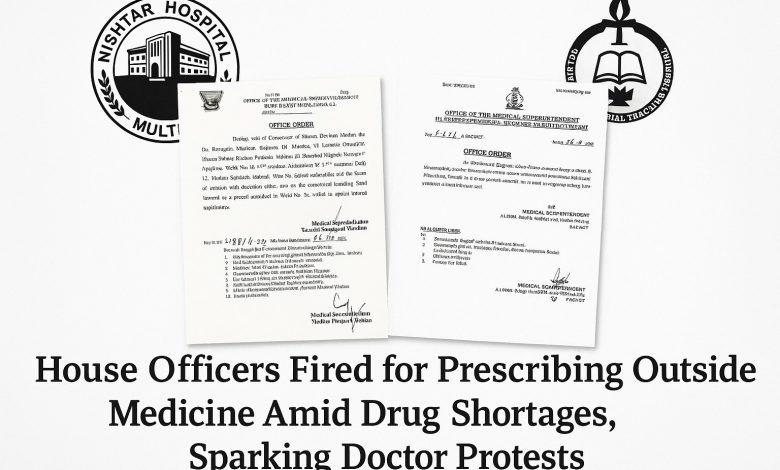
Dr. Ruqayya Mahnoor Qureshi, a house officer at Nishtar Hospital in Multan, was suspended after allegedly prescribing medication to a patient from a private pharmacy because the required drugs were not available in the hospital. The suspension, ordered by the hospital’s Medical Superintendent and circulated to provincial health officials, cited this action as a violation of hospital regulations and announced a formal inquiry.
A similar incident occurred in Sialkot, where Dr. Muhammad Sagheer, serving in the General Surgery department at Allama Iqbal Memorial Teaching Hospital, was terminated for prescribing medicine sourced from outside the hospital during his shift in the surgical emergency unit. Hospital authorities stated that his actions were against institutional policy.
These disciplinary actions have drawn sharp criticism from young doctors and professional organizations, who argue that junior staff are being unfairly targeted while systemic problems go unaddressed. Dr. Hassan Baloch, convener of the Young Doctors Federation, denounced the firings, stating that house officers work strictly under supervision and have limited authority. He questioned whether it was reasonable to expect doctors to withhold necessary treatment solely because of hospital supply shortages, and accused administrators of blaming junior staff to hide deeper failures within the system.
Medical staff at other institutions, including Jinnah Hospital Lahore and Nishtar Multan, have voiced similar concerns, questioning whether doctors should be punished for acts intended to save lives when public hospitals cannot meet basic pharmaceutical needs. There are growing calls within the medical community for thorough investigations and collective action to protect junior doctors from punitive measures in similar situations.
House officers are recent medical graduates in a compulsory, supervised training year, integral to hospital care delivery. Their roles range from routine patient management to assisting in critical procedures. While they are required to comply with guidelines from the Pakistan Medical and Dental Council (PMDC) and hospital policies, they often face the challenge of inadequate medical resources within the hospitals.
The incidents draw attention to long-standing problems in Pakistan’s public health sector, where essential medicines are frequently out of stock despite a national essential drug list. Prescribing from external pharmacies, although against official policy, is sometimes seen as the only option for doctors under pressure to provide care with limited resources.
Medical experts note that broader issues—such as irrational prescribing practices, uneven drug distribution, and the influence of pharmaceutical companies—further complicate the healthcare environment. International agencies and local studies have repeatedly warned about these systemic vulnerabilities in Pakistan’s health system.
The Young Doctors Association, known for staging large-scale protests over poor working conditions and systemic neglect, is now pressing for the reinstatement of the dismissed house officers and calling for reforms to improve transparency, drug availability, and policy enforcement. The ongoing investigations into these cases are expected to influence future protocols and could redefine professional boundaries and ethical standards for junior doctors working in overstretched public hospitals.