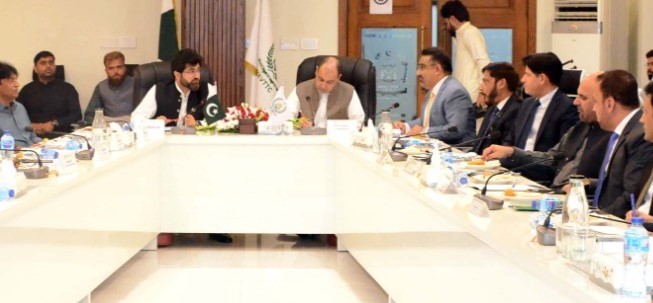
A Senate committee has urged comprehensive reforms in Pakistan’s vocational and technical training system to increase skilled labour participation domestically and enhance international employment prospects. The Senate Standing Committee on Overseas Pakistanis and Human Resource Development convened under Senator Zeeshan Khanzada at the National Vocational and Technical Training Commission (NAVTTC) headquarters, calling for an improved alignment of vocational programs with domestic and international labour market demands.
At the outset, Senator Khanzada highlighted serious concerns regarding the low number of skilled workers in Pakistan. He indicated that of the roughly 70 million working-age individuals, only two million are classified as skilled workers. Pakistan’s national labour force participation rate currently stands at 44.9%, significantly lagging behind regional counterparts such as Bangladesh (58.3%) and Vietnam (73.69%). In response, the committee stressed the need for immediate, strategic action to bridge this gap.
NAVTTC officials presented detailed employment data tracking outcomes of the commission’s training initiatives. According to their statistics, approximately 53% of the individuals trained by NAVTTC successfully found employment. Of these, 38% reported monthly earnings exceeding PKR 50,000, while 18% earned between PKR 31,000 and PKR 50,000. Around 27% earned up to PKR 30,000 per month, whereas approximately 17% of the respondents declined to disclose their income. Moreover, NAVTTC announced collaborations with Punjab Bank and the National Bank of Pakistan, which will facilitate student loans secured by NAVTTC-backed guarantees.
In a comparative context, NAVTTC officials outlined Pakistan’s relatively strong performance in training effectiveness. Officials cited a tracer study that indicated Pakistan’s employment rate for skilled graduates was 53%, with trainees usually securing employment within six months to a year after training. By comparison, Sri Lanka reported a 54.5% employment rate one year post-training, and Bangladesh recorded only a 39% employment rate two years post-training.
Additionally, NAVTTC shared insights concerning job types secured by trained individuals. The majority (64%) obtained full-time wage employment, while 14% engaged in part-time wage positions. Another 18% became self-employed, and the remaining 4% were employed as daily wage earners or in informal employment arrangements. The Information Technology sector stood out as the top employment destination, accommodating 32% of trainees, followed by Construction and Energy at 12%, and the Banking and Finance sector at 6%. Officials also highlighted that 25,079 NAVTTC-trained professionals migrated abroad for employment over the past four years.
Addressing the quality and scope of data used, Senator Khanzada emphasized the urgent necessity for more accurate and up-to-date labour statistics. He criticized the reliance on outdated data, noting that the last labour force survey was completed in 2021. He further advocated that future labour surveys be aligned with official census data rather than approximations or estimates to ensure proper planning and accurate assessments.
Regarding provincial training quotas, the committee raised questions about fairness and equity. NAVTTC representatives clarified that unused provincial quotas were reallocated among other provinces. However, Senator Zameer Hussain Ghumro challenged this arrangement, arguing that the need for frequent reallocations suggested either regional disparities or administrative shortcomings. He requested detailed province-specific information on training partnerships and financial resource allocation be provided at the committee’s next session.
Committee members further expressed concerns regarding limited public awareness of NAVTTC training programs, particularly in rural or underserved regions. Senator Khanzada underlined that while Information Technology-centric training remains essential, substantial attention must also be devoted to Pakistan’s large manual labour population. He encouraged expansion of specific training programs tailored to developing skills in critical vocational disciplines such as heavy vehicle driving, electric vehicle mechanics, welding, agriculture, and livestock management, all of which he identified as integral to the country’s economic growth.
Significantly, the meeting was attended by Senators Zamir Hussain Ghumro, Gurdeep Singh, Syed Kazim Ali Shah, Nasir Mehmood, along with senior officials from relevant ministries and departments, underscoring the importance of collaborative and coordinated efforts in reforming Pakistan’s technical education and labour market strategies.