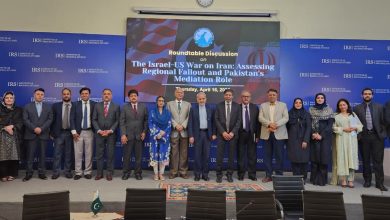
A report produced by the Institute of Regional Studies in partnership with the Beaconhouse Centre for Policy Research argues that recent Indian moves are contributing to its growing marginalization and a changing strategic environment in South Asia. The study, titled Building Peace in South Asia: Post-Pahalgam Scenario, is based on a joint dialogue held after the May 2025 crisis and brings together insights from leading Pakistani experts on regional security.
Ambassador Jauhar Saleem, president of the Institute of Regional Studies, said the May 2025 military escalation exposed a shift in India’s strategic doctrine from a nuclear-calibrated, status-quo approach to a more assertive, risk-tolerant posture. He cited Operation Sindoor as an example of efforts to reshape deterrence by raising costs for Pakistan, while noting that Pakistan’s measured response prioritized regional stability and safeguarded national sovereignty.
Senator Mushahid Hussain Syed warned that current India policy is increasing New Delhi’s isolation in South Asia and beyond. He also pointed to a shift in U.S. policy that removed a degree of strategic cover for India, changing calculations in New Delhi and prompting a dramatic recalibration with implications for regional security.
Ambassador Aizaz Ahmed Chaudhry praised the report for offering practical strategies and highlighted cross-border terrorism as an ongoing point of contention. He voiced concern about the risk of renewed Indian aggression potentially driven by domestic pressures and the pursuit of national prestige.
Ambassador Mansoor Ahmed Khan of the Beaconhouse Centre for Policy Research urged Pakistan to use its strategic position to advance regional integration. He recommended deeper diplomatic and economic engagement with Bangladesh, Sri Lanka, Maldives, Nepal and Bhutan as part of a broader approach to strengthen regional security while countering attempts at diplomatic isolation.
The report launch drew a wide audience of serving diplomats, former ambassadors, scholars, researchers, members of the media and university students. Attendees said the document provides a resourceful roadmap for Pakistan to protect its interests, reduce tensions and pursue a principled path to lasting peace in the region.