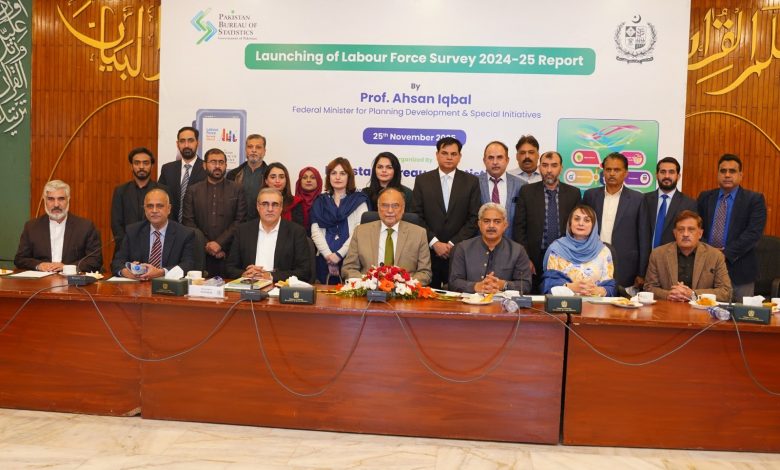
Pakistan has formally released the Labour Force Survey 2024–25 after adopting the ICLS-19 international standards, a move confirmed and highlighted by Federal Minister for Planning Professor Ahsan Iqbal during the launch. The updated methodology aligns national statistics with global best practice and aims to improve the credibility and comparability of workforce data.
The survey reveals a notable expansion of the national labour market: the labour force rose from 71.8 million to 83.1 million, an increase of 11.3 million. Employment grew from 67.3 million to 77.2 million, up by 9.9 million, while the number of unemployed increased from 4.5 million to 5.9 million, a rise of 1.4 million measured under both standards. Key indicators moved as well, with labour force participation climbing from 44.9% to 46.3%, the employment-to-population ratio edging from 42.1% to 43.0%, and the unemployment rate rising from 6.3% to 7.1%.
Adoption of ICLS-19 in the Labour Force Survey has strengthened international alignment and improved reporting transparency by publishing results under both old and new standards. This dual reporting approach enables policymakers, researchers and analysts to interpret trends more accurately and supports evidence-based decision making across government and the private sector.
The survey offers a comprehensive view of employment, wages, sectoral distribution, female labour participation, entrepreneurial activity and unpaid care work, providing actionable insight on structural shifts in Pakistan’s labour market. These findings highlight emerging opportunities for youth and women and are intended to guide policy interventions, business planning and development partnerships focused on inclusive job growth.
With the Labour Force Survey now meeting global statistical benchmarks, government agencies and stakeholders in Pakistan will be better placed to design targeted programs and investments that respond to changing labour market realities and promote sustainable employment outcomes.