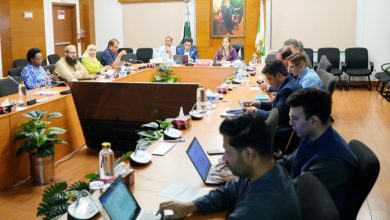
The Centre for Afghanistan, Middle East & Africa convened the second working session of the Islamabad Conclave to examine transnational terrorism and emerging security challenges in South Asia. The session brought together policymakers and academics to assess evolving militant networks, cross-border dynamics and the political drivers that sustain violence across the region.
Dr Amina Khan of CAMEA warned that expanding transnational networks have intensified terrorism in South Asia as groups forge alliances and replicate tactics across borders. She cautioned that actions resembling ethnic cleansing by unaccountable actors embolden extremists and stressed that states seeking international legitimacy must honour international norms and counterterrorism responsibilities to preserve regional stability.
Senator Mushahid Hussain Sayed delivered the keynote address highlighting Asia’s shift from unipolarity to multipolarity and the continent’s rising influence. He pointed to popular movements in Bangladesh, Sri Lanka and Nepal as expressions of regional civic resilience while identifying cross-border aggression and doctrines such as Akhand Bharat as significant security challenges for Pakistan. The senator urged public empowerment and stronger cooperation on climate, population pressures, health and education, and he noted the strategic role of initiatives like China’s BRI and the SCO framework in addressing terrorism.
Ambassador Asif Durrani reflected on the selective use of the terrorism label and Pakistan’s long experience with non-state militancy, warning that politicised narratives dating back to the 1980s complicate reconciliation and development. He argued that practical counterterrorism progress depends on regional cooperation, mutual understanding and pragmatic policymaking rather than zero-sum approaches.
Dr Hu Shisheng described cross-border militancy as a sophisticated regional problem, observing that over 90 percent of terrorist attacks in 2023 occurred in conflict zones and that militants exploit unresolved disputes and permissive environments. He stressed that durable stability requires enhanced cross-border cooperation, grievance reduction and economic opportunity expansion to undercut militant recruitment and operations.
Dr Shahab Enam Khan highlighted the growing role of ideological extremism driven by non-state actors and the weaponisation of resources and information, especially through social and digital media. He emphasised community-led resilience, women’s empowerment and inclusive governance as essential to preventing extremist narratives from taking root.
Dr Shabana Fayyaz underscored gaps in regional security cooperation as militants evolve beyond traditional proxy models. She cited the presence of groups such as Al Qaeda, ISKP and IMU and warned that technology and cyber vulnerabilities complicate counterterrorism efforts. Dr Fayyaz called for preventive dialogue and a comprehensive regional framework to tackle the changing threat environment.
The session concluded with an engaging question and answer segment that reinforced calls for diplomacy over force in Afghanistan, greater coordination among South Asian states, and sustained investment in social and economic initiatives to reduce the appeal of violent extremism. Participants agreed that addressing transnational terrorism will require a combination of political will, regional cooperation and long-term development strategies focused on reducing grievances and strengthening institutions.