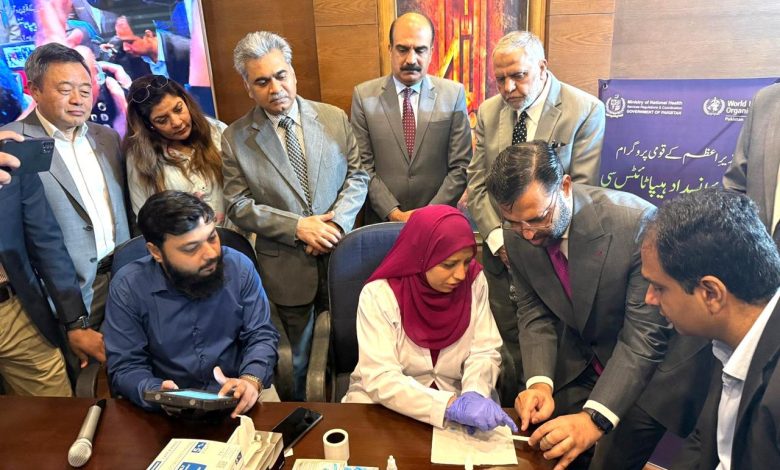
The Prime Minister’s National Programme for the Elimination of Hepatitis C was launched today in the Islamabad Capital Territory with a target to reach 1.6 million people in the next six months as the first phase of a nationwide effort backed by the World Health Organization.
Federal Health Minister Syed Mustafa Kamal and WHO Representative Dr Luo Dapeng observed a rapid hepatitis C test during the launch, underscoring the programme’s emphasis on mass screening, diagnosis and timely treatment. The initiative builds on pilot phases that provided operational lessons for nationwide scale up.
Pakistan carries one of the heaviest hepatitis C burdens globally, with an estimated 10 million people living with the infection. Around 110,000 new infections occur each year in Pakistan, driven largely by unsafe medical injections and blood transfusions, while injection drug use accounts for a significant share. Globally, only about one in three people with hepatitis C know their status, making large-scale testing a priority.
With technical support from WHO and leadership from the Ministry of National Health Services, Regulations and Coordination, the Hepatitis C programme will offer prevention measures, widespread testing and life-saving antiviral treatment for those who test positive. The launch in Islamabad is intended as a fast-moving model that will be introduced in subsequent phases across the country, aiming to screen more than 164 million people nationwide over time.
Officials estimate that over the next five years the programme could save roughly 3.3 billion Pakistani rupees through reduced treatment and hospitalization costs, and that by 2030 every dollar invested could yield about eight dollars in national returns. Long-term projections suggest the programme could avert up to 850,000 deaths and prevent about 1.1 million new infections by 2050 if implemented at scale.
WHO has pledged continued technical collaboration, stressing that detecting and treating hepatitis C is critical but prevention remains central. Measures highlighted include preventing mother-to-child transmission, enforcing safe injection and blood transfusion practices, and expanding harm reduction services. The Hepatitis C programme in Pakistan aims to combine these prevention efforts with rapid diagnosis and treatment to meet the World Health Assembly goal of eliminating hepatitis C as a public health threat by 2030.