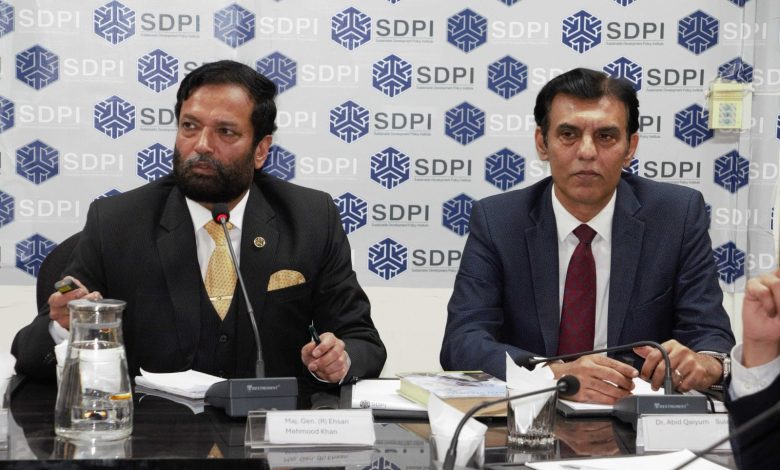
Islamabad, 13 January 2026 — Major-General (R) Ehsan Mehmood Khan outlined the central role of governance and internal systems in securing human wellbeing during a lecture at the Sustainable Development Policy Institute. Speaking on concepts and practices of comprehensive security and sustainable development, he traced the evolution of security from ancient times to the modern state and argued that the state�s core purpose must be peace, security and inclusive prosperity.
Drawing on his book Human Security in Pakistan, first published in 2013 and taught at international institutions including the National Defense University in Washington, he emphasised that national security has no fixed definition and has been shaped by conflict, institutional innovation and policy shifts. He noted milestones such as the 1947 US National Security Act that institutionalised national security frameworks later emulated worldwide.
Presenting a model for Pakistan�s Comprehensive National Security, he described three interlinked rungs: global security, state security and human security, with the latter two forming the operational core. True security, he said, requires simultaneous progress across territorial, political, diplomatic, economic, cultural and human dimensions to create what he called a corridor of prosperity.
During the question-and-answer session he stressed that human security cannot be separated from state security and that robust state security does not automatically undermine human wellbeing. Instead, weak governance and poor resource utilisation are the real risks to service delivery and citizen welfare, underscoring the need for reform of internal systems to deliver public services effectively.
He also assessed Pakistan�s current posture, saying the country maintains effective comprehensive deterrence against threats while acknowledging that some existential challenges still demand traditional security responses. For long-term stability and sustainable development, he urged an emphasis on governance reforms and strengthened internal systems that translate policy into reliable service delivery.
Pointing to Pakistan�s socio-economic strengths, he highlighted over 10 million overseas Pakistanis, strong remittance inflows and the world�s third-largest freelance community as assets that can support resilience. He called on policymakers to build internal capacities so that security and development reinforce each other, arguing that comprehensive security is only achievable through balanced progress across all fronts of national life.