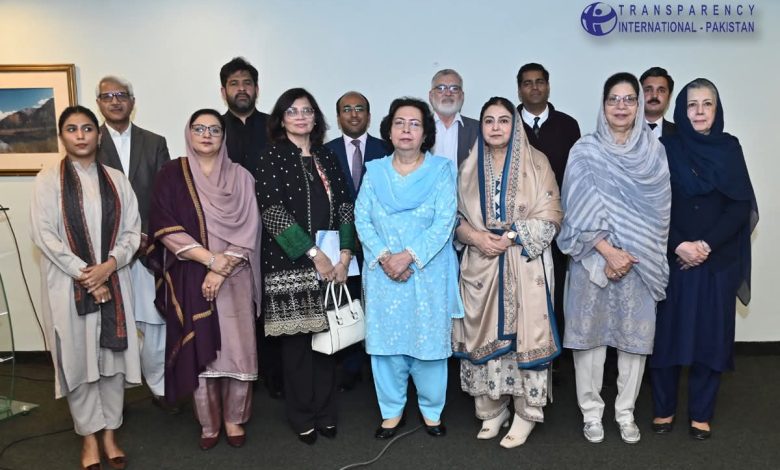
Transparency International Pakistan convened a high-level consultative meeting with parliamentarians in Islamabad on February 17, 2026 to discuss strengthening carbon markets and legislative readiness under Article 6 of the Paris Agreement. The session brought together members of the National Assembly and Senate Standing Committees on Climate Change and Environmental Coordination, and parliamentarians from across party lines to consider the statutory foundations needed for credible and inclusive market development.
Professor Dr. Uzma Shujaat of the TI Pakistan Board of Trustees opened the meeting by warning that carbon markets offer a major opportunity to mobilize climate finance and support low-emission development only if backed by strong governance and transparent oversight. She stressed that Parliament must ensure systems protect national interests, preserve market credibility and deliver equitable benefits to affected communities.
Kashif Ali, Executive Director of TI Pakistan, presented the organisation’s legislative roadmap for parliamentarians, urging enactment of a Carbon Markets Framework Act to legally recognise carbon credits, Internationally Transferred Mitigation Outcomes and Verified Emission Reductions as intangible assets. The proposed law would clarify ownership rules, distinguish public, private and community-generated credits, and set out their treatment in contracts, taxation and dispute resolution to reduce investor uncertainty while protecting community rights.
Speakers emphasised the urgent need for a national Monitoring, Reporting and Verification system and consolidated emissions baselines aligned with Article 6. Technical recommendations included building domestic MRV capacity, integrating data systems and codifying benefit-sharing and community safeguards. Mandatory provisions for Free, Prior and Informed Consent and robust grievance redress mechanisms were highlighted as essential to ensure projects on public or communal land deliver fair returns to local stakeholders.
Hamid Sarfraz of Dev Consult warned that Pakistan’s climate governance architecture remains fragmented across federal and provincial tiers, limiting coordination, finance tracking and data integration. He called for enhanced parliamentary oversight through the Council of Common Interests and clearer institutional mandates to enable effective implementation of NDC commitments and to support functioning carbon markets.
Hamza Rafay Butt from UNEP-WCMC outlined Pakistan’s potential for carbon finance across energy, forestry, waste and agriculture, while noting that market credibility depends on consolidated baselines, transparent governance and integrated data. He linked these readiness gaps directly to the legislative priorities discussed and warned that translating technical findings into law is key to attracting international carbon finance without compromising integrity or inclusion.
Providing a legal perspective, Syed Bulent Sohail argued that policy guidelines alone cannot deliver legal certainty and urged formal notification of carbon market rules. He presented an assessment of existing policies and laws and underlined the need to mainstream climate considerations across legal frameworks to reduce investor risk, boost international credibility and safeguard community rights.
Parliamentarians present expressed strong interest in advancing carbon markets through an Act of Parliament aligned with national development priorities and Article 6, and pledged to pursue the issue through private member bills, resolutions and other parliamentary instruments. The discussion underscored the need for coordination across federal and provincial institutions and for transparent data and reporting systems to underpin credible market operations.
Closing the consultation, Ms. Munaza Hassan, Chairperson of the National Assembly Standing Committee on Climate Change and Environmental Coordination, reaffirmed Parliament’s central role in creating the statutory backbone for carbon markets and ensuring climate finance supports national and community priorities. Participants left with a shared recognition that Pakistan is entering a formative phase in carbon markets where legislative clarity, institutional coordination and inclusive governance will determine the country’s ability to mobilise climate finance and deliver equitable benefits.