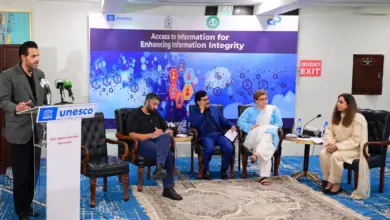
The Centre for Strategic Perspectives at the Institute of Strategic Studies, Islamabad convened a focused session on regional cooperation that examined the intertwined challenges of economic growth and climate change for South Asia. Senior policymakers, development experts and civil society leaders discussed practical steps to mobilise finance, modernise industry and strengthen transboundary water governance.
Haroon Sharif delivered a forward-looking keynote urging a results-driven approach to regional cooperation amid global uncertainty and shrinking development finance. He proposed a platform of digital collaboration, climate-focused partnerships and an expanded role for emerging investors including China and Gulf states, stressing private sector-led solutions and youth empowerment as central to implementation.
Mr Sharif warned that existing bilateral water treaties are insufficient for rapidly changing Himalayan hydrology and advocated trilateral water-management arrangements alongside a regional climate and development bank to address the shortfall in global climate finance.
Dr Safdar Sohail highlighted the link between industrial policy and climate action, noting Pakistan’s weak alignment between the two. He cautioned that measures such as the EU’s Carbon Border Adjustment Mechanism create new non-tariff barriers and urged coordinated regional technology transfer, greener value chains and support for low-carbon industrial transition to preserve export competitiveness.
Dr Pema Gyamtsho emphasised that the Hindu Kush Himalaya’s natural capital is a core regional asset and called for shared data platforms, joint early-warning systems and coordinated resilience investments that protect both mountain and downstream communities. He argued that integrating natural capital into planning is essential for sustainable growth across borders.
Dr Dilli Raj Khanal shared Nepal’s experience in scaling hydropower exports, engaging with carbon markets and community forest management, while warning that national commitments are outpacing available financing. He urged regional pathways to accelerate clean energy, green growth and the development of low-carbon industries.
Ms Aisha Khan framed climate change as the region’s foremost security challenge, with melting glaciers, altered monsoon patterns and worsening water scarcity likely to eclipse traditional geopolitical tensions. She proposed a South Asian climate agreement and a regional climate finance mechanism that centres human wellbeing and ecological stability.
The session underscored practical levers for advancing regional cooperation, including harmonised industrial and climate policies, coordinated investments in resilience, and the creation of institutional mechanisms for shared water governance and climate finance. An interactive question-and-answer segment explored governance options and pathways for Pakistan to align domestic policy with regional opportunities.
The event concluded with Ambassador Khalid Mehmood, Chairman Board of Governors at ISSI, presenting commemorative mementos to the speakers, reflecting a collective call for action that places regional cooperation at the heart of economic and climate solutions for South Asia.