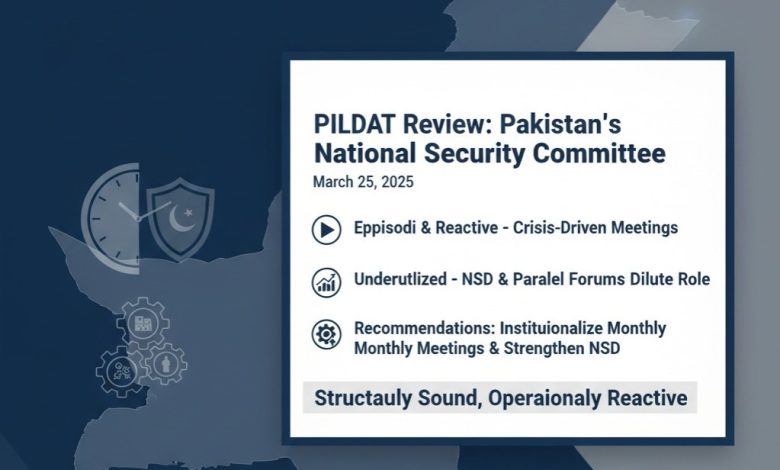
PILDAT’s annual review finds Pakistan’s National Security Committee was convened three times in the year following the second anniversary of Prime Minister Muhammad Shehbaz Sharif’s term, but its role remained largely episodic and reactive rather than institutionalized.
The April–June 2025 meetings were called in response to the Pahalgam attack in Indian Illegally Occupied Jammu and Kashmir and the ensuing cross-border escalation. The June 2025 session also assessed wider regional developments, including Israeli military strikes on Iran, demonstrating the NSC’s potential as a forum for strategic deliberation beyond immediate bilateral crises.
PILDAT notes that irregular use of the National Security Committee has limited the effectiveness of the National Security Division, which was intended to provide analytical and operational support. Because the NSC met infrequently, the NSD remained underutilized and unable to fully supply evidence-based analysis or sustained strategic planning.
At the same time, increased reliance on parallel coordination mechanisms — such as Apex Committees under the National Action Plan and other high-level ad hoc meetings — has diluted the institutional prominence and strategic coherence of the National Security Committee, producing overlapping mandates and weaker accountability.
PILDAT recommends that the government institutionalize the NSC as a regular forum for strategic civil-military consultation, scheduling monthly meetings to review domestic and international security developments proactively. Strengthening the NSD’s analytical, operational, and coordination capacities is essential to support long-term strategic planning. It is also critical to reaffirm the NSC as Pakistan’s principal platform for national security decision-making and to clearly delineate its role relative to parallel committees to avoid duplication and improve accountability.
The second year of Prime Minister Shehbaz Sharif’s term reflects a national security architecture that remains structurally sound but operationally reactive; adopting PILDAT’s recommendations would shift the system toward more sustained, evidence-based strategic consultation.