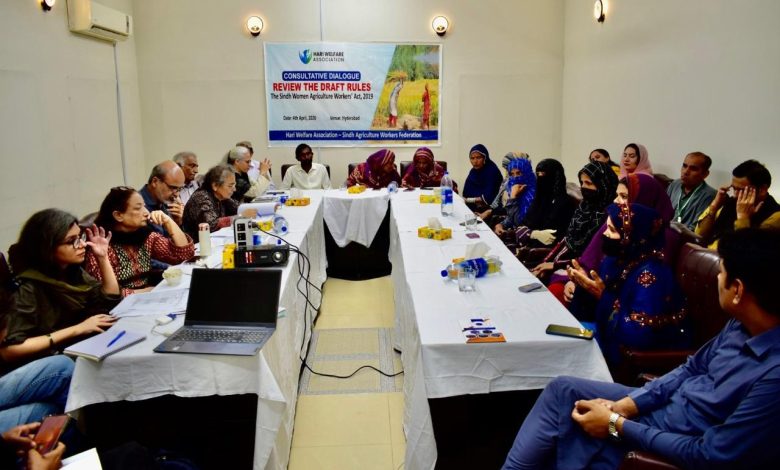
The Sindh Cabinet has approved rules under the Sindh Women Agriculture Workers Act 2019, but civil society participants at a consultative dialogue in Hyderabad warned the rules lack key protections and an effective accountability mechanism. The dialogue was organised by Hari Welfare Association and brought together community members, trade unions, the Human Rights Commission of Pakistan and other civil society groups to review implementation gaps and propose reforms.
Speakers welcomed the passage of the 2019 Act and the recent approval of its rules, while stressing that recognition alone will not secure rights for women in farming. Akram Khaskheli, president of Hari Welfare Association, noted that the Act finally acknowledges the contribution of women in agriculture yet highlighted a broader absence of enforceable accountability across labour laws that weakens protection in practice.
Participants raised persistent gender-based wage disparities, observing that women agricultural workers commonly receive lower pay than men for equivalent work. Registration barriers were flagged as a major obstacle, with no clear mechanisms to register women workers and support them at the union council level, while district-level processes often remain inaccessible due to mobility and structural constraints.
Concerns about weak implementation extended to digital systems. The Labour Department has developed online registration platforms, but these systems remain underused and require urgent activation to reach women in rural areas. Drawing on Labour Force Survey data, Haris Ghazdar and others argued that official figures undercount the true number of women working in agriculture, underscoring the need for accurate data to inform policy.
Speakers emphasised that the Act recognises unpaid work, including production for household consumption, in line with international standards such as those of the International Labour Organisation, yet many provisions remain unimplemented despite judicial pressure. Civil society organisations including HRCP, women trade unions and HWA had filed a writ petition seeking implementation of the Act and approval of the rules, reflecting growing legal advocacy to enforce rights for Sindh women workers.
Zahra Khan, General Secretary of the Home-Based Women Workers Federation, called for social protection measures, including extending Employees’ Old-Age Benefits Institution coverage to agricultural workers beyond age 60. Qazi Khizar of HRCP warned that bonded labour remains widespread in agriculture and is not explicitly addressed in the current rules. Peasant women from Mirpurkhas described market injustices where low harvest prices later surge, enriching middlemen and landlords, and urged fair pricing mechanisms to protect producers.
Voicing practical solutions, a participant from Mirpurkhas urged clearer definitions of worker categories—skilled, semi-skilled and unskilled—to ensure fair wages, and recommended translating the Act and rules into Sindhi and other local languages to improve comprehension among farming communities. Advocate Sara Malkani pointed out inconsistencies between the Act’s definition of “worker” and the draft rules, and flagged ambiguous provisions such as committee formation under Article 16-B that lack clarity on administrative levels.
Nasir Mansoor of the National Trade Union Federation pushed for a tripartite framework involving workers, employers and government, noting the absence of such collaboration and raising concerns about third-party contracting that allows employers to evade responsibility. Researcher Kausar S. Khan observed that key stakeholders were not consulted during drafting and urged alignment of worker registration with existing industrial laws and simplification of procedures for women who face barriers similar to those experienced with institutions like NADRA.
Participants expressed frustration that earlier feedback from women trade unions and other stakeholders was not reflected in the final rules. The consultative group agreed to submit formal recommendations and objections to the Labour Department and said legal avenues could be pursued if necessary to uphold rights-based standards for Sindh women workers. The meeting concluded with a commitment to raise these issues in a follow-up dialogue scheduled for April 8 in Karachi, with contributions also from Rafia Gulani, Samina of Azad Hariyani Trade Union Nawabshah, and Allah Rakhi, President of Nari Hariyani Mazdoor Trade Union Matiari.