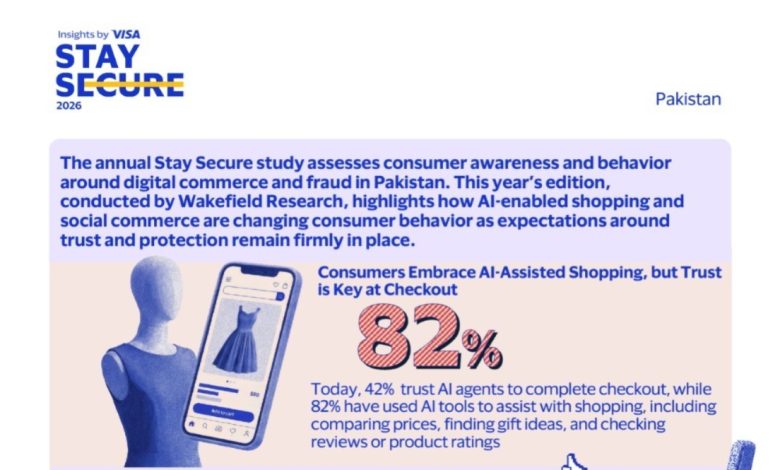
Visa’s Stay Secure study in Pakistan finds that AI shopping tools are already a major part of consumer routines, with 82% of respondents saying they have used AI to assist with purchases. Shoppers most commonly use these tools to compare prices, find gift ideas and check reviews or product ratings, and 93% say such technologies make online shopping faster and easier.
AI is also shaping discovery, as 55% of consumers report typically discovering new brands or retailers while shopping online. Despite this rapid adoption, trust remains a limiting factor: only 42% of Pakistani consumers would trust AI agents to complete checkout on their behalf, underscoring a clear gap between convenience and confidence in agentic commerce.
The study shows growing belief that AI can help fight fraud. About 65% of respondents feel AI has made scams easier to recognize today, and 87% believe AI will play a critical role in protecting consumers from fraud in the future. These views reflect rising expectations that technology should be part of the solution as digital commerce evolves.
Social commerce is now mainstream in Pakistan, with 82% of consumers having bought directly through social platforms. At the same time, fraud follows the channels consumers use: 55% reported experiencing a financial scam in the past 12 months, and among those victims 44% say the scam occurred on social media rather than on an app, website or marketplace.
Parents and caregivers express real concern about children’s exposure to online scams. Seventy‑seven percent report that children in their lives struggle to recognize scams, 33% have seen a child fall victim while gaming or shopping online, and 44% of parents say their children can access mobile payment apps or digital wallets.
When it comes to responsibility for protecting shoppers, consumers look to institutions first. Forty‑nine percent believe payment providers and online marketplaces should be primarily responsible, followed by government authorities (36%) and banks or financial institutions (31%), while just 13% say consumers themselves should hold primary responsibility. Shoppers also want proactive reassurance, with 51% saying real‑time alerts from their bank or payment app would make them feel secure and 33% saying a familiar, trusted logo at checkout would increase their comfort.
Leila Serhan, Senior Vice President and Group Country Manager for North Africa, Levant and Pakistan at Visa said the findings show momentum for digital commerce in Pakistan alongside a persistent demand for trust. “As commerce moves toward more agentic, AI‑powered experiences, the study shows that consumers are embracing the convenience AI can bring to shopping but remain cautious when it comes to AI completing purchases on their behalf,” she said, adding that Visa is focused on partnerships, real‑time protections and secure‑by‑design innovation to build confidence across the region.
The Stay Secure study was commissioned by Visa and conducted by Wakefield Research between January and February 2026, surveying 5,800 adults across 17 CEMEA markets including Pakistan. The findings highlight a clear challenge for local merchants, payment providers and regulators: deliver the convenience of AI shopping while accelerating trust at checkout and stronger protections across social commerce channels.