**Federal Minister Qaiser Ahmed Sheikh Calls on Youth to Lead Economic Transformation through Innovation and Entrepreneurship**
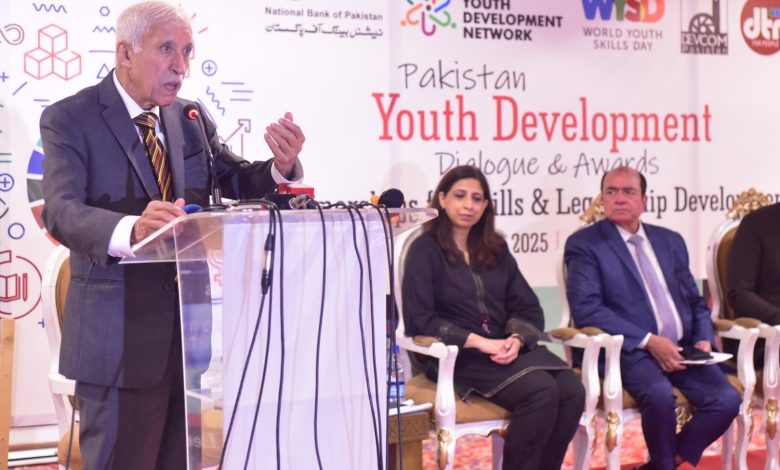
Federal Minister for Investment and Chairman of the Board of Investment, Qaiser Ahmed Sheikh, has urged Pakistan’s youth to drive the nation’s economic growth by embracing innovation, skill development, and entrepreneurship. Speaking at the Pakistan Youth Development Dialogue 2025 in Islamabad, the minister delivered an impassioned keynote address, emphasizing the pivotal role of young people in shaping Pakistan’s future and outlining concrete steps to harness their potential.
Addressing a hall full of young participants, Qaiser Ahmed Sheikh highlighted that Pakistan’s most valuable asset is its youthful population, noting their capacity to ignite economic and social transformation. He praised the active engagement of attendees, contrasting it with other forums where youth participation is limited. Commending the event organizers and host Shoaib, he said, “This spirit of participation is exactly what Pakistan needs right now.”
Drawing on his international experience, Sheikh referenced youth inclusion models in countries such as China, where intergenerational collaboration is a key component of policy-making and leadership development. He advocated for Pakistan to adopt similar structures, where young people are directly involved in learning and decision-making processes rather than acting as passive observers. “Their success was rooted in structured inclusion and long-term investment in their younger generation. Pakistan must adopt similar models,” he argued.
The minister also addressed the evolving global job market, observing that practical skills are increasingly valued above formal degrees, and citing the information technology sector as a prime example. He shared insights from his role as a longtime Board of Governors member at FAST National University, highlighting its graduates’ successes in international tech firms like Microsoft. He added that advancing access to quality IT education in smaller cities, such as through the FAST campus in his hometown Chiniot, was vital for inclusive growth.
Turning to employment trends, Qaiser Ahmed Sheikh encouraged young Pakistanis to shift their mindset away from reliance on government jobs and instead build careers through entrepreneurial ventures. Drawing from his experience as a former president of the Karachi Chamber of Commerce and Industry, he underscored the value of practical business exposure and outlined opportunities in industries like indenting, brokerage, and commission-based trade, which require limited capital but considerable initiative. “Government doors are closing. Don’t wait for employment — create it,” he advised.
Sheikh stressed that Pakistan’s youth are growing up in a world defined by digital connectivity and globalized trade, providing them with unprecedented tools and opportunities. He cited the Prime Minister’s Youth Loan Scheme and welcomed the removal of collateral requirements for loans up to 1.5 million rupees, but called for further simplification of access to financial resources for enterprising youth.
The minister also placed Pakistan’s current moment in a broader regional context, observing a global shift in economic focus toward South Asia and noting increased international interest, particularly from Middle Eastern investors, amidst shifting geopolitical dynamics. He reaffirmed the government’s commitment to creating a business-friendly environment for young entrepreneurs and attracting investment in high-growth sectors such as minerals and technology.
In closing, Qaiser Ahmed Sheikh encouraged young people to pursue optimism, cultivate practical skills, and step boldly into leadership roles, telling the audience, “Pakistan’s future belongs to those who are ready to think, act, and lead. The opportunities are real — you just have to reach for them.”
The event concluded with the minister distributing souvenirs to speakers, marking the end of a productive dialogue that left participants energized and motivated to take on the challenges ahead.