Experts Urge Pakistan to Intensify Advocacy for Kashmir, Warn Against Restoration of Statehood as a Superficial Measure
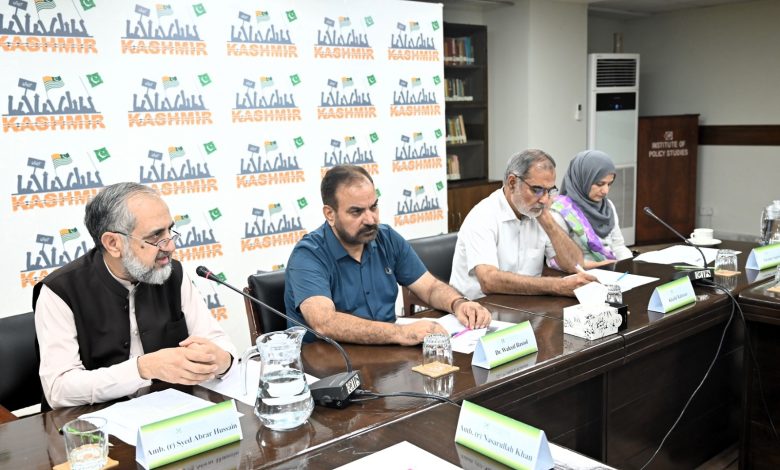
A high-level discussion convened by the Institute of Policy Studies (IPS) emphasized that any move by India to restore statehood to Jammu and Kashmir would signal a retreat from its controversial actions of August 2019. Participants argued that amid growing internal unrest in India, increased international attention, and shifting global power structures, Pakistan should seize the moment to reinforce its support for the Kashmiri people’s right to self-determination.
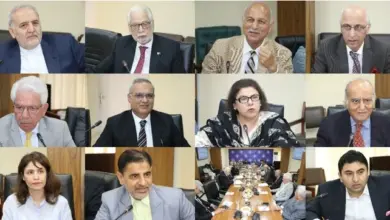
The session, titled “Restoring Statehood of IOJ&K: A Step Forward or Political Mirage?”, brought together policy analysts, diplomats, legal experts, and security analysts. Key contributors included Khalid Rahman, Chairman of IPS, Ambassador (retired) Syed Abrar Hussain, Dr. Sheikh Waleed Rasool of the Institute of Multi-Track Dialogue, Farzana Yaqoob of WGK, Brigadier (retired) Khurshid Khan, legal and international affairs experts Brigadier (retired) Raja Shozeb Majeed and Brigadier (retired) Said Nazir.
Dr. Sheikh Waleed Rasool described the historical context, noting that Kashmir’s struggle has always involved a contest between India’s control in practice and the region’s legal status. He said that India’s revocation of Kashmir’s special status violated international agreements and constitutional guarantees, and he urged Pakistan to highlight these legal issues in global political, legal, and humanitarian forums.
Adding to the legal and historical analysis, Brigadier Khurshid Khan criticized India for widespread human rights violations in the region, pointing out that recent skirmishes have placed Kashmir back on the international agenda. He stressed the importance of Pakistan leveraging its new United Nations Security Council (UNSC) resolution, which endorses peaceful dispute settlement, to boost diplomatic efforts.
Brigadier Shozeb Majeed highlighted the strategic dimensions, asserting that India might attempt to apply strategies similar to those seen in Palestine. However, he claimed that recent confrontations have exposed vulnerabilities in India’s regional dominance. He encouraged Pakistan to seek an advisory opinion from the International Court of Justice (ICJ), utilize shifting international public opinion, partner with global think tanks, and document victims’ accounts through multimedia to spotlight human rights abuses.
From a defense perspective, Brigadier Said Nazir noted that Pakistan has reasserted its deterrence following recent clashes, warning that any normalization of Indian military assertiveness would be costly for New Delhi.
Ambassador Abrar Hussain condemned India’s August 2019 actions as unconstitutional and contrary to international law, noting that they were intended to coerce Kashmiris into submission. However, he argued that recent incidents have reignited global focus on the Kashmir issue, intensifying calls for resolution.
Summing up the discussion, IPS Chairman Khalid Rahman observed that since India’s 2019 move, the country has faced increased diplomatic and strategic isolation. He said it remains unclear whether statehood would be restored fully or if the territory would remain divided. Regardless of the outcome, he urged Pakistan to build upon this shifting geopolitical context to press even harder for the Kashmiri right to self-determination.