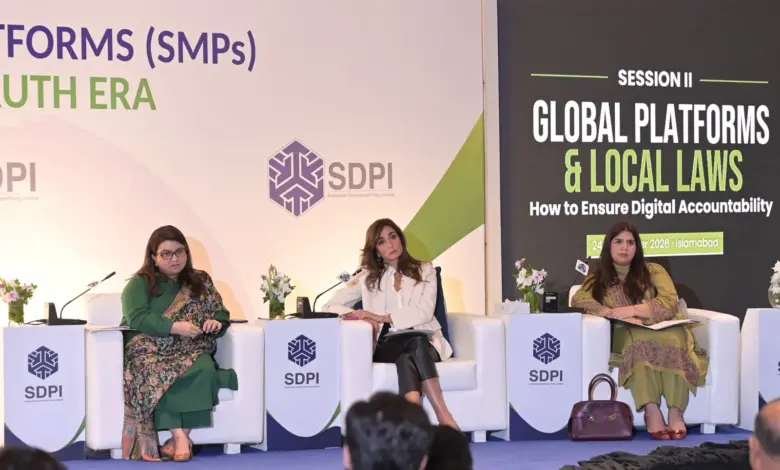
ISLAMABAD: Federal Minister for Information Technology and Telecommunication Shaza Fatima Khawaja has said that Pakistan needs a balanced and coordinated approach to address online harms, with national security, counter-terrorism, citizen protection and privacy remaining top priorities while preserving digital innovation and emerging opportunities.
Speaking during a panel discussion at an SDPI seminar in Islamabad, the minister said online regulation must take into account the protection of citizens as well as the growth of the digital economy. She stressed that there could be no compromise on matters involving national security, terrorism and the privacy of citizens.
Responding to a question, Shaza Fatima said challenges often emerge when the community guidelines of social media platforms do not match local laws and ground realities. She noted that many online issues fall in “grey areas”, where context is necessary because every matter is not explicitly covered in local legislation.
She said complaints sent to platforms must clearly explain the relevant legal provisions and local background so that companies can properly assess and respond to them. Submitting large numbers of complaints without legal references or contextual details, she added, could reduce compliance by platforms.
The minister said the government was dealing with multiple concerns, including threats to national security, citizen privacy, smear campaigns, misinformation and possible economic harm. She said the severity and urgency of each issue must guide the response.
According to her, threats to national security, terrorism and human life and safety stand at the highest level of priority. Gender-based abuse, especially abuse directed at female public figures, also requires serious attention, while financial and economic security, defamation and misinformation should be assessed according to their context and immediacy.
Shaza Fatima said online decisions could not always be made through a simple black-and-white approach. For example, she said, visual content that appears to show weapons may not on its own meet a platform’s removal threshold, even if authorities have additional information that gives the content a serious security context. This, she said, makes it essential to explain evidence, attribution and circumstances behind complaints.
The minister acknowledged that engagement with social media companies had improved over the years, but said further progress was required. She said the government was in contact with platforms on complaint redressal mechanisms, standardised templates and better coordination.
She said the Pakistan Telecommunication Authority had played an important facilitative role in engagement with platforms. However, she noted that PTA’s core mandate was focused on licensing operators and networks, while the changing nature of digital challenges required specialised institutional capacity.
In this regard, she referred to the roles of the Social Media Regulatory Authority and the National Cyber Crime Investigation Agency, saying they were strengthening their capacities within their respective mandates to understand, contextualise and address such issues.
Calling for a proportionate response, the minister said banning or blocking a platform should be considered only at the final and most extreme stage in a wider range of measures. She said public awareness, digital literacy and the ability of citizens to distinguish correct information from falsehood were essential parts of the response.
She said awareness initiatives by the media, the information sector and technology platforms could help create a safer online environment. Every action by users and platforms, she added, should carry clear and proportionate consequences under a well-defined regulatory framework.
Such a framework, she said, should strengthen accountability without imposing excessive restrictions that could undermine innovation. She described technology as being like water, saying people would continue to use it and find alternative routes. Policies, therefore, should avoid pushing young people towards unregulated platforms or services beyond existing oversight.
The federal minister also expressed the government’s commitment to stricter action against anti-state propaganda, while distinguishing it from legitimate and constructive criticism. She said there should be zero tolerance for false and organised propaganda against Pakistan, its state institutions or individuals.
She said the government remained in dialogue with social media platforms and other governments on these matters, including the use of geo-fencing. Pakistan’s position, she added, was that content involving serious violations should be removed globally instead of being restricted only within Pakistan through geo-fencing.
Shaza Fatima said another challenge was the concealment of identities by those involved in harmful online activities through AI-generated or unrelated images, unidentifiable names and hidden locations. She said the government was also working to address cross-border activities, including cases where people involved in anti-state activities could have links with terrorist networks.
Such links, she said, raised grave security concerns and required sustained cooperation. Pakistan, she added, was advancing cooperation with friendly countries through threat intelligence arrangements and memoranda of understanding.
The minister also referred to the work of the National Cyber Security Centre and said the National Cyber Security Authority was in the establishment phase. Together with continued engagement with digital platforms, these initiatives were aimed at strengthening Pakistan’s capacity to counter emerging cyber and security threats.
She said the persistent spread of anti-state propaganda meant that the volume of complaints submitted to platforms remained significant. The government, she added, was in contact with platforms to improve mechanisms for dealing with accounts and networks involved in such activities.
The minister said she had directed the Ministry to adopt a lasting response against repeat offenders, including action against profiles that are recreated with minor changes to usernames, such as adding a dot or repeating letters.
Concluding her remarks, Shaza Fatima said countering online harms required a whole-of-ecosystem approach involving security agencies, regulatory bodies, the Ministry, social media platforms, media and citizens. She expressed confidence that continuous coordination, improved threat intelligence, context-based complaints, public awareness and proportionate regulation could help overcome these challenges while enabling Pakistan’s digital economy and innovation ecosystem to flourish.