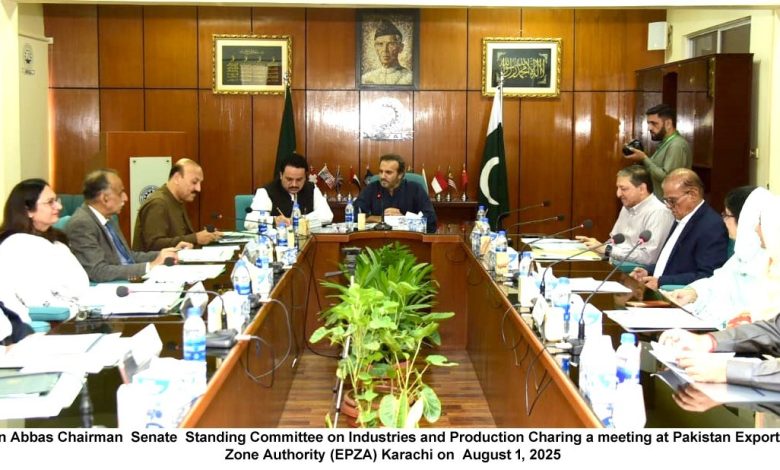
A Senate committee has called for urgent reforms to boost investor confidence and address operational challenges in Pakistan’s export processing zones, following a detailed visit to the Export Processing Zones Authority (EPZA) headquarters in Karachi. The Senate Standing Committee on Industries and Production, led by Senator Aon Abbas, engaged in discussions with EPZA officials about pressing legal, administrative, and taxation issues that have hindered foreign and local investment.
Committee members, including Senators Syed Masroor Ahsan, Danesh Kumar, Saleem Mandviwalla, Khalida Ateeb, and Husna Bano, focused especially on the impact of shifting tax policies. EPZA Chairman AD Khwaja highlighted that inconsistent taxation has caused significant confusion among investors and undermined the benefits historically offered by the export processing zones. The committee recognized that uncertainty surrounding taxation remains one of the biggest barriers to industrial expansion and investment.
To address these challenges, the committee urged immediate coordination among the EPZA, the Federal Board of Revenue, and the Ministry of Finance. Their goal is to harmonize tax regulations and establish consistent policies, ensuring a stable and supportive environment for businesses operating within the zones.
Other operational hurdles were also discussed during the meeting. EPZA officials outlined problems such as limited available land for industrial expansion, inadequate infrastructure, lack of scanning facilities, and bureaucratic delays, particularly regarding the Sialkot and Gujranwala zones’ administrative transfers. Recurring fire incidents, delays in digitizing business processes, and staffing shortages were also raised as ongoing concerns.
Legal obstacles remain another significant challenge for the authority. The committee learned that a growing number of court cases—currently 99 pending, including 18 filed by investors—often relate to non-performing or closed industrial units. Recent legal changes, including processes under the Sindh Civil Courts Amendment Act 2025, have further complicated matters by transferring cases from higher to district courts, causing additional delays.
The Senate committee directed EPZA to compile a comprehensive report on all ongoing land allotment-related litigation, stressing the importance of maintaining clear, accurate records of land distribution and ownership to prevent future disputes.
Senator Aon Abbas commended EPZA’s ongoing efforts and assured the authority of the committee’s full support in pursuing legislative and administrative reforms needed to revitalize export processing zones and attract sustainable industrial investment into Pakistan.