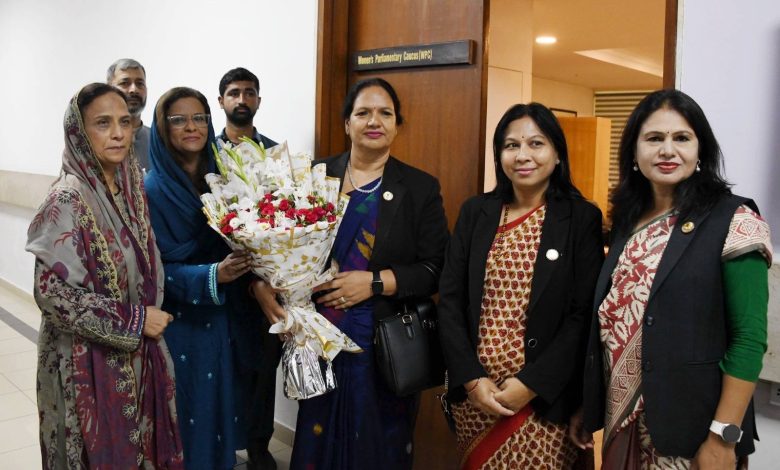
A delegation of women parliamentarians and civil society leaders from Nepal visited Pakistan’s National Assembly in Islamabad to discuss strategies for promoting gender-responsive budgeting and women’s empowerment in South Asia. The meeting, organized by the Women’s Parliamentary Caucus (WPC) of Pakistan with support from Friedrich-Ebert-Stiftung (FES), facilitated an exchange of policy experiences and best practices between the two countries.
Dr. Shahida Rehmani, Secretary of the WPC and Member of the National Assembly, welcomed the Nepali group and emphasized Pakistan’s commitment to integrating gender considerations into government reforms. She highlighted that gender-responsive budgeting is crucial not only for aligning national resources with the needs of women and marginalized groups but also for amplifying women’s voices in shaping policies and priorities.
Nepali delegates shared details of their recent efforts to advance gender equality, including the implementation of mandatory quotas for women across different governance levels, scholarship programs for girls, financial incentives such as reduced property taxes for women, and subsidized loans for women entrepreneurs. They also discussed the challenges faced in organizing a parliamentary caucus in Nepal and acknowledged Pakistan’s leadership in championing women’s legislative representation in the region.
On Pakistan’s side, Dr. Nafisa Shah, Chairperson of the Special Committee on Gender-Mainstreaming, discussed how the WPC and the Gender Mainstreaming Committee work together to pursue legal reforms and reduce gender disparities. Senator Fauzia Arshad outlined legislative progress on issues such as ending child marriage, enhancing inheritance rights for women, criminalizing honor killings, and prioritizing gender inclusion in laws and policies.
The participants also reviewed Pakistan’s current gender budgeting strategy, its upcoming federal budget consultations, and the use of a gender budget tagging methodology that tracks government spending on social services, economic empowerment, responses to gender-based violence, and climate resilience.
The session concluded with both delegations expressing a commitment to deeper regional cooperation and a proposal for the Women’s Parliamentary Caucus of Pakistan to make a reciprocal visit to Nepal.