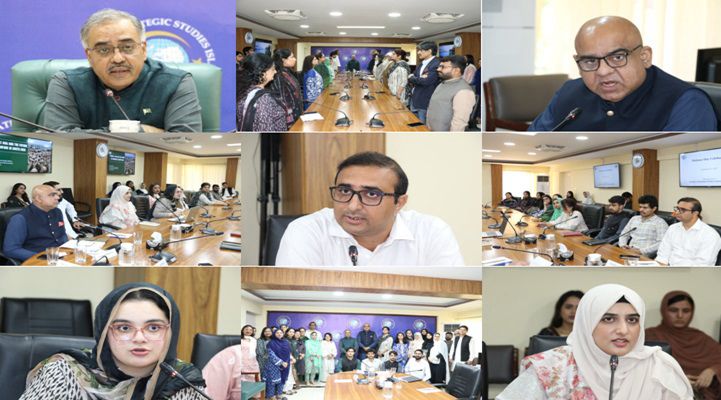
The Arms Control and Disarmament Centre at the Institute of Strategic Studies Islamabad held a Defence Day commemoration under the theme “Marka-e-Haq and the Future of Warfare in South Asia,” bringing together ISSI researchers, interns and students to reflect on recent military tensions with India, the region’s deterrence dynamics, and the impact of emerging technologies on future conflict. Speakers paid tribute to the armed forces and martyrs, reviewed the evolution of Pakistan’s deterrent posture, and called for modernization and strategic preparedness alongside continued support for dialogue.
Ambassador Sohail Mahmood, Director General of ISSI, opened the event by honoring the sacrifices of the armed forces and martyrs in defending Pakistan. He traced the country’s strategic trajectory from early conflicts through the decision to develop nuclear capabilities, arguing that Pakistan’s nuclear tests removed an existential threat and strengthened national defence. He warned against any misconception that limited conventional war beneath a nuclear threshold is feasible, stressing that while Pakistan favors constructive engagement and result-oriented dialogue, it will respond firmly to threats to its sovereignty and territorial integrity. He said Pakistan’s swift and professional response to recent aggression had demonstrated national resolve and enhanced its international standing. He also emphasized that defence is multidimensional, encompassing national unity, economic strength, social cohesion and robust military capability.
Malik Qasim Mustafa, Director of the ACDC, said that despite a ceasefire following recent clashes, India’s actions and evolving doctrine raised concerns for regional peace and deterrence stability. He argued that New Delhi appears to be shifting toward doctrines that combine nuclear and conventional war-fighting postures. Mustafa called for efforts to bolster Pakistan’s deterrence, including modernization of military capabilities and delivery systems to deter future attacks, aggression or unintended escalation.
Research assistants Aleena Afzal and Hadia Akhtar presented on “Marka-e-Haq and the Future of Warfare in South Asia,” reviewing the Pahalgam incident and Pakistan’s response to the unprovoked aggression earlier this year. They highlighted how integrated multi-domain operations—linking land, sea, air, cyber and space—will shape future conflicts, and identified disruptive technologies such as artificial intelligence, unmanned systems, hypersonic weapons, cybersecurity tools and network-centric warfare as key factors that will transform regional military competition. They argued that commemorating Defence Day should include preparing for these technological and doctrinal changes.
In an interactive session, participants said this year’s observance carried renewed significance. For many young people who associated Defence Day primarily with earlier wars, recent events brought its relevance into the present. Discussants underscored that Pakistan’s nuclear capability remains a defining element of South Asia’s strategic balance and that, while advanced weapons matter, sound strategy and national resolve ultimately determine outcomes.