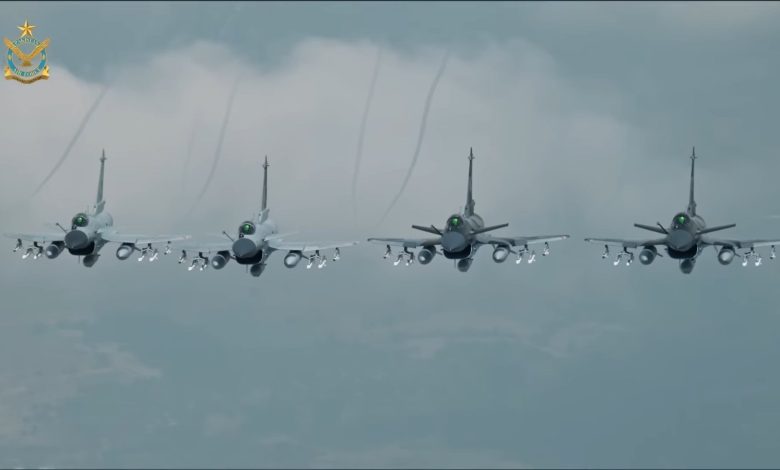
Pakistan’s J-10C “Indus Dragons,” configured with long-range PL-15 missiles and short-range PL-10 weapons, has become a central element of the Pakistan Air Force’s air superiority strategy. The aircraft’s advanced radar, modern engines, and new weapons integration have expanded stand-off engagement options and, according to Pakistani officials, were used effectively in recent aerial engagements with India, demonstrating a step-change in the service’s capabilities.
The J-10C is a 4.5-generation multirole fighter produced by China’s Chengdu Aircraft Industry Group. Pakistan operates the export J-10CE variant in a role focused on air superiority and defensive counter-air missions. The type combines a swept airframe with a modern turbofan engine, an active electronically scanned array radar, an infrared search-and-track sensor, helmet-mounted sights, and advanced electronic warfare avionics, giving it improved detection, targeting, and survivability compared with older fighters in the region.
In its typical air-to-air configuration for the Pakistan Air Force, the J-10C carries four PL-15 beyond-visual-range air-to-air missiles and two PL-10 short-range missiles. The PL-15 export variant is estimated to have an effective range on the order of 145 kilometers and uses an active radar seeker with a dual-pulse solid rocket motor and electronic counter-countermeasures features. The PL-10 is a highly maneuverable, imaging-infrared guided missile with thrust-vectoring and high off‑boresight capability, typically mounted on wingtip pylons to maximize engagement angles. Pakistan’s J-10Cs also use dual-ejector racks that allow two long-range missiles to be mounted on a single pylon, increasing missile load without major aerodynamic penalties.
Operationally, the J-10C is intended to exploit stand-off engagement: its AESA radar and sensors can detect and track targets at longer ranges than many legacy radars, allowing crews to engage adversaries while reducing exposure. Analysts estimate the J-10C’s radar offers a substantial detection-range advantage over older systems such as the F-16C Block 52 in service with regional air forces. The platform is also being fielded as part of a networked approach to combat, linked to airborne early-warning aircraft and other fighters through a domestic data link that enables cooperative targeting and “silent” operations where a J-10C can be cued by off-board sensors without switching on its own radar. Integrated electronic countermeasures are a further element of its doctrine, intended to degrade adversary situational awareness and protect PAF assets.
Pakistani officials report that the J-10C/PL-15 combination saw combat use during recent air clashes with India, including engagements in which J-10Cs allegedly shot down Indian Rafale fighters at long ranges. Those accounts claim at least one Rafale was struck from an engagement distance approaching 200 kilometers, which, if confirmed, would rank among the longest-range air-to-air kills on record. Pakistani statements and some analysts attribute these outcomes to a combination of underestimation of PL-15 range by Indian planners, effective sensor-to-shooter data links that shortened decision cycles, and electronic warfare measures that hampered Indian radar and communications. Independent verification of specific claims varies between sources.
On the technical side, Pakistan’s J-10CEs incorporate several enhancements over earlier models. The aircraft are fitted with the WS-10B turbofan, which offers improved thrust and climb performance compared with older engines. The KLJ-10 AESA radar provides multi-target tracking and engagement capabilities, and the use of dual-ejector racks increases the number of long-range missiles the airframe can carry. These features collectively allow the J-10C to operate as a high-end element within a broader force mix that still includes F-16s and JF-17s.
Looking ahead, analysts expect Pakistan to continue expanding and modernizing its J-10C fleet, with projections of significantly larger procurement over the long term and potential upgrades to missiles, sensors, and data links. Developments under discussion include variants of the PL-15 with folding fins for internal carriage in future stealth designs, improved battle network interoperability, and further sensor enhancements. Combat performance attributed to the fleet has also been noted as a potential boost to China’s defense export prospects.
The induction and operational use of the J-10C in the Pakistan Air Force has altered local aerial force dynamics by providing a modern stand-off strike capability and enhanced networked operations. While official Pakistani accounts credit the type and its weapons with notable combat success, independent confirmation of some claims is limited, and assessments vary by source. Nevertheless, the J-10C’s combination of advanced sensors, new engines, and long-range missiles represents a clear upgrade in Pakistan’s ability to contest airspace and project deterrence.