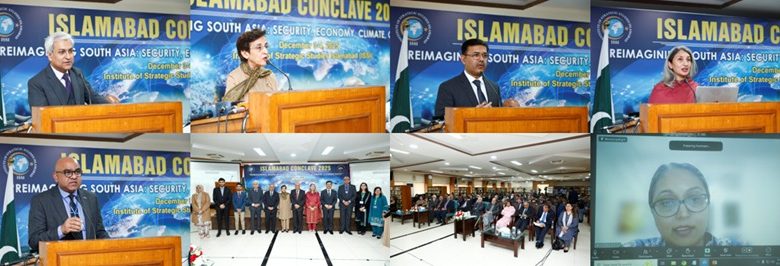
The Institute of Strategic Studies Islamabad convened the Islamabad Conclave 2025 under the theme Reimagining South Asia, and on December 3 the Arms Control & Disarmament Centre hosted Working Session III on emerging strategic security challenges and charting a peaceful path for Pakistan.
Ambassador (R) Tehmina Janjua delivered the keynote, arguing that strategic security now covers a wide spectrum of military and non-military threats directly affecting Pakistan’s safety. She identified India’s hegemonic ambitions reinforced by Hindutva as the principal regional challenge and described Afghanistan’s dynamics as driven by deep-rooted irredentist impulses amplified by the Taliban’s ideological posture. Ambassador Janjua urged a systematic review of Pakistan’s policy approach and highlighted climate change and water insecurity as urgent non-military priorities that must be integrated into any strategic security framework.
Malik Qasim Mustafa, Director of ACDC, set the context by noting how South Asia’s complexity stems from both traditional tensions and rapidly emerging risks. He warned that Emerging and Disruptive Technologies such as artificial intelligence, hypersonic systems, drone swarms and cyber tools are reshaping deterrence and strategic stability, while India’s growing maritime and nuclear presence in the Indian Ocean is altering the security calculus for littoral states. He stressed that Pakistan’s geography gives it potential to advance regional cooperation if policy is oriented accordingly.
Dr Zahir Kazmi examined the spread and impact of EDTs, citing autonomous weapons, AI-enabled systems, cyber capabilities, hypersonic delivery and unmanned underwater vehicles as forces changing escalation dynamics. He noted that international efforts to regulate Lethal Autonomous Weapons Systems have stalled, leaving legal and institutional frameworks playing catch-up. Dr Kazmi emphasised the need for Pakistan to build institutional foresight to respond to a rapidly evolving strategic security environment.
Dr Nishara Mendis highlighted that South Asia’s future is closely linked to the Indian Ocean, where naval modernisation and enhanced maritime domain awareness are increasingly essential. She pointed to three regional deficits—the absence of a cohesive security architecture, weak economic cooperation and a lack of integrated regional frameworks—that limit states’ ability to manage both longstanding disputes and new threats. Dr Mendis called for collaborative regional mechanisms to address these gaps.
Dr Salma Malik argued that Pakistan’s geostrategic advantages, including the Arabian Sea coastline, Gwadar Port, proximity to the Strait of Hormuz and overland access to Central Asia, can only be fully realised with a coherent strategy. She warned that persistent challenges such as the Kashmir dispute, tensions along the Afghan border, competition with India over Afghan affairs and the decline of SAARC constrain that potential. Domestic stability, economic resilience, balanced partnerships and diplomatic agility were singled out as prerequisites for translating geography into security and prosperity.
Ambassador Tahir Hussain Andrabi warned that intensifying great-power rivalry, rapid technological advances and blurred nuclear thresholds are creating dangerous spillover risks across South Asia. He observed that India’s nuclear modernisation and pursuit of a full triad, coupled with shorter missile flight times and AI-enabled systems, compress decision windows and raise the likelihood that conventional actions may be interpreted through a nuclear lens. While Pakistan has mounted a multidomain response, Ambassador Andrabi cautioned that future crises are likely to be faster, more interconnected and more unstable, leaving the regional security architecture fragile.
Speakers at the session converged on the need to integrate arms control thinking, maritime strategy, climate and water security and regulatory measures for emerging technologies into Pakistan’s strategic security planning. The Islamabad Conclave discussion underscored that addressing these intersecting challenges will require stronger institutions, regional cooperation and a calibrated foreign policy to preserve stability and advance a peaceful path for Pakistan.