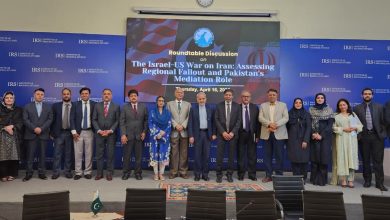
Senior policymakers, diplomats and climate experts gathered at the Institute of Strategic Studies Islamabad for a roundtable on Pakistan’s COP30 strategy, mapping negotiation priorities and preparedness ahead of Belem, Brazil. Participants included Ambassador Sohail Mahmood, Ambassador Khalid Mahmood, Mr. Jamil Ahmad of UNEP, Ms. Nadia Rehman of the Ministry of Planning, Ms. Sadia Munawar of the Ministry of Climate Change, and climate finance specialist Ms. Kashmala Kakakhel.
Dr. Neelum Nigar opened the discussion by underlining the need to revisit the national approach to climate diplomacy in light of Pakistan’s recent 2025 floods, stressing that adaptation and equitable climate finance must be central to any COP30 strategy. She framed the moment as one requiring alignment between international commitments and Pakistan’s development and vulnerability profile.
Ambassador Sohail Mahmood described COP-30 as a defining moment to shift from promises to measurable results, noting Pakistan’s progress since COP-29, including the National Adaptation Plan 2025–2030 and the launch of the Pakistan Climate Resilience Financing Framework. He emphasized pragmatic, equity-driven negotiation stances that prioritize operationalizing the Loss and Damage Fund, technology access, and South-South cooperation to attract investment and resilience-building technologies.
In a video message, Mr. Jamil Ahmad of UNEP called COP-30 the COP of Implementation, urging that commitments become tangible actions at national and local levels. He highlighted the Living Indus Initiative as a practical model linking water security, biodiversity and livelihoods that can inform Pakistan’s COP30 strategy.
Ms. Nadia Rehman urged a shift from traditional group alignments toward an issue-based negotiation posture focused on climate finance and technology transfer, and she recommended rethinking sovereign risk and credit-rating frameworks to unlock concessional funding. Ms. Sadia Munawar outlined Pakistan’s multi-tiered COP preparations with provincial showcases from Punjab, Sindh, KP, Balochistan, Gilgit-Baltistan and AJK, and reiterated targets such as increasing renewable energy share to 60 percent by 2030 and expanding green finance instruments.
Ms. Kashmala Kakakhel provided a candid assessment that Pakistan must sharpen its negotiation focus and pursue grant-based, programmatic funding rather than over-relying on debt. She urged stronger private sector and academic engagement to develop indigenous climate technologies alongside international technology transfer, reinforcing a COP30 strategy geared toward resilience financing and practical adaptation.
The roundtable discussion saw interventions calling for stronger national commitment, regional cooperation on transboundary challenges and grassroots awareness to translate policy into local impact. Ambassador Khalid Mahmood closed by thanking participants and confirming that insights from the meeting will inform Pakistan’s preparatory work for COP-30 and beyond, reinforcing ISSI’s role in shaping a focused and actionable COP30 strategy.