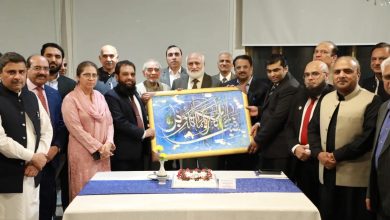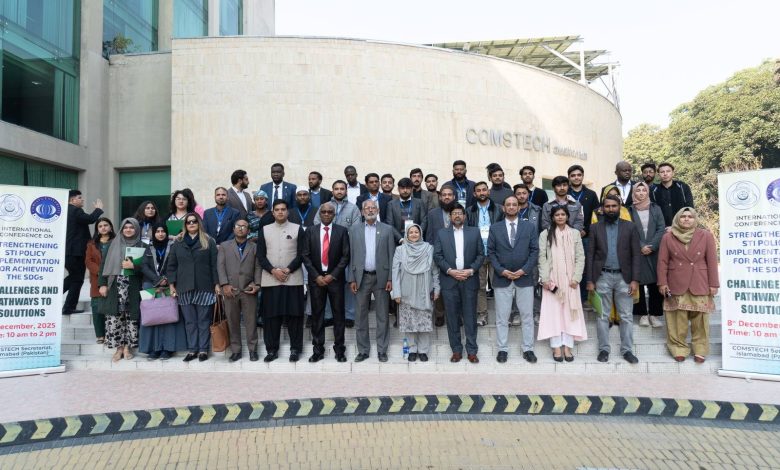
An international conference on strengthening STI policy for achieving the SDGs took place at the COMSTECH Secretariat in Islamabad on December 8, 2025, bringing together academics, policymakers and students from Pakistan and abroad, with many participating online. The event, organised by OIC-COMSTECH and COMSATS University Islamabad, focused on closing implementation gaps and translating national strategies into measurable development outcomes.
Prof. Dr. Mudassir Asrar, Adviser Science Policy at OIC-COMSTECH, speaking for the Coordinator General, underscored the mounting pressures of climate change, food and energy insecurity, and public health vulnerabilities in developing countries and made the case for stronger national STI policy frameworks. He emphasised that mission-oriented, coordinated approaches are essential to align science and innovation with SDG priorities across the OIC region.
Speakers examined institutional bottlenecks and policy gaps in themed sessions that combined regional case studies with conceptual models. Dr Hammad Omer from COMSATS University discussed models for aligning STI policy with Sustainable Development Goals, while Dr Kalsoom Sumra reviewed continental policy frameworks and their implications for developing regions and for Pakistan’s policy landscape.
Addressing the crucial role of youth and entrepreneurship, Prof. Dr Muazzam Khattak of Quaid-i-Azam University urged investment in innovation ecosystems that support start-ups and university spinouts. In health policy sessions, Dr Tariq Mahmood Ali of the Health Services Academy stressed that evidence-based research must directly inform policy choices to strengthen public-health resilience.
Dr Ismaila Diallo, Regional Advisor for OIC-Africa, outlined recurring constraints that limit STI policy implementation across member states and presented a draft framework intended to guide development and execution of effective national strategies. Participants welcomed the framework as a starting point for harmonised regional action while noting the need for stronger institutional support and multi-stakeholder engagement.
Gender inclusion and equity in science and technology emerged as a key theme, with Dr Javeria Ambreen of COMSATS University highlighting persistent disparities and calling for targeted measures to increase women’s participation in research institutions. Regional perspectives were enriched by Dr Mitra Aminlou from Iran, who shared examples of policy successes and failures that offer lessons for OIC countries.
Dr Khaleel Malik from the University of Manchester discussed how university–industry collaboration can bolster national innovation capacity, citing practical approaches to bridge academic research and commercialisation. Speakers repeatedly pointed to capacity building, research mobility and knowledge-sharing as priorities for advancing STI policy implementation.
Delegates concluded that while many OIC states have formulated national STI strategies, persistent implementation gaps require mission-focused programs, widened stakeholder participation and stronger linkages between policy, research and industry. The conference reinforced COMSTECH’s role in facilitating cooperation, technical training and regional knowledge exchange to accelerate SDG progress through improved STI policy.