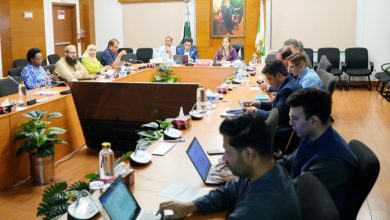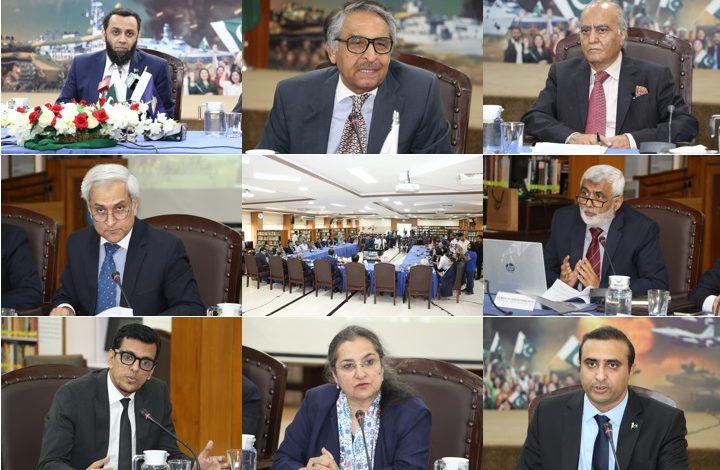
The India Study Centre at the Institute of Strategic Studies Islamabad and Digital Debate marked the first anniversary of Marka-e-Haq with a seminar attended by senior civilian and military leaders. Federal Information Minister Attaullah Tarar participated as Chief Guest and former Foreign Minister Ambassador Jalil Abbas Jilani was the Guest of Honour, while speakers included Ambassador Khalid Mahmood, Ambassador Tahir Hussain Andrabi, Air Marshal (Retd) Farooq Habib, Ms. Nasim Zehra, Dr. Khurram Abbas and Mr. Ahmad Hassan Al-Arbi.
In his welcome remarks, Ambassador Khalid Mahmood observed that May has repeatedly shaped Pakistan’s strategic trajectory and argued that the country’s response combined battlefield success with diplomatic outreach and information management. He urged that the gains of Marka-e-Haq be consolidated into institutional, economic and intellectual strength through national unity and long-term strategic foresight.
Attaullah Tarar criticised what he described as unsubstantiated allegations from India following a false flag operation, noting that an FIR was registered rapidly without credible investigation. He said Pakistan countered misinformation through timely engagement with international media and diplomatic channels, underlined the offer of a transparent joint investigation, and praised the professionalism of the armed forces and indigenous technological capabilities in defending national sovereignty.
Ambassador Jalil Abbas Jilani placed India’s aggressive posture in the context of recent years and argued that the pattern of blaming Pakistan after incidents is familiar. Referring to May 2025, he said India’s narrative did not gain international acceptance amid concerns over transnational targeting, rising Hindutva-driven extremism and strained ties with neighbours, and he warned that moves like suspending the Indus Waters Treaty raised serious international alarm about the weaponization of water.
Dr. Khurram Abbas recalled that the conflict last May was imposed on Pakistan despite efforts to avoid armed confrontation and said the country’s response sent a clear strategic message that coercion and intimidation would not be accepted. Ambassador Tahir Hussain Andrabi outlined Islamabad’s diplomatic campaign, noting the Prime Minister’s offer for a joint investigation and intensive outreach that included calls with some 60 capitals to advance Pakistan’s perspective.
Air Marshal (Retd) Farooq Habib discussed the kinetic side of the May 2025 confrontation, describing coordinated preparations by the Air Force, Army and Navy to turn tactical gains into strategic advantage and stressing vigilance as warfare changes with advanced technologies and unmanned systems. Ms. Nasim Zehra highlighted Pakistan’s efforts to resist regional hegemonic pressure while expanding strategic partnerships, particularly with China, and deepening engagement in West Asia.
Ahmad Hassan Al-Arabi examined the centrality of strategic narrative formation in modern conflict, describing how mobile platforms, AI, OSINT and citizen journalism shape the information battlefield. He argued that Pakistan’s emphasis on truth, transparency and real-time communication during the May events, supported by youth-led digital practitioners, helped neutralise a well-resourced disinformation apparatus and turned perception into a decisive multiplier.
Speakers agreed that sustaining the diplomatic, informational and institutional gains from Marka-e-Haq will require continued unity, investment in indigenous capabilities and strategic patience. The seminar concluded with participants gathering for a group photograph.