When education becomes a burden instead of empowerment, what happens to the dreams of Pakistan’s Middle Class students?
By:Fajar Fatima Tariq
Walk into any Pakistani university classroom and watch closely. You’ll see students physically present but mentally drowning…. in unpaid dues, part‑time job fatigue, or the guilt of being a financial burden. No one records them. No statistic counts them. But every year, hundreds of dreams die not from lack of talent… but from lack of bus fare, hostel money, or the next fee deadline.
Then ask: How many dreams are silently buried under university fees, transport costs, and societal pressure
Have you ever considered WHY?
Why are middle class families forced to sacrifice everything just to afford education?
Why do talented students fall behind simply because of financial limitations?
And most importantly Can a nation progress when its students are exhausted before even entering professional life?
For Pakistan’s middle class, education was once the great promise..the surest path to security, respect, and a better life for the next generation. But today, that promise is breaking. Across the country, middle-class families are discovering a painful truth: the system designed to uplift them is now pushing them to the edge.
Raised questions usually have answers…Right?
But in this case we have to find them ourselves…
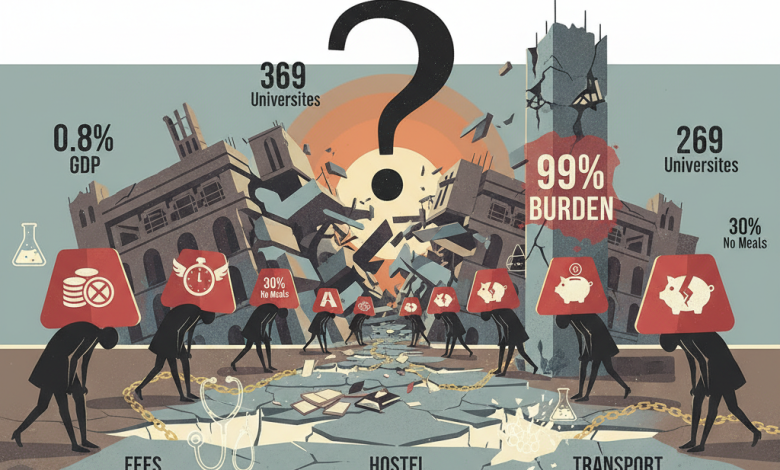
The numbers tell a brutal story. Pakistan spends only 0.8 percent of its GDP on education—far below the 4 percent recommended by UN agencies . To put this in perspective, India spends 4.6 percent, Bhutan spends 7 percent, and even Afghanistan, despite its challenges, allocates 2.9 percent .
Dawn (June 10, 2025) – “Economic Survey 2024-25: Education spending plummets to 0.8pc of GDP” quoted “The cumulative expenditure on education by the federation and the provinces remained merely 0.8 per cent of the Grand Domestic Product (GDP)”
There is no statistic that captures the 2 a.m. anxiety of a student calculating whether their parents can afford next semester’s fees. There is no survey that measures the guilt of asking for more money. But the impact is real.The Pakistan Panel Household Survey (PPHS), conducted by the Pakistan Institute of Development Economics, reveals that 30 percent of households cannot afford three meals a day .Pakistan now has 269 universities—160 public and 109 private . On paper, this sounds like progress. But quantity has come at the cost of quality.
Many public universities are facing severe financial difficulties. “Some cannot even make payrolls and have to cut pension payments,” reports Dawn. “Some of the new universities in the public sector have not been given any support at all by the HEC”
Where as many families from the lower-middle and middle classes cannot even afford to enroll their children in O/A levels programs due to the high cost of tuition, examination fees, and associated expense: (The News International (January 9, 2025) – “Beyond reach” – Letter by Dr. Intikhab Ulfat, Karachi)
While The middle-class student occupies a cruel no-man’s-land: too wealthy for scholarships, too poor to pay without pain.No one gives them aid. No one calls them underprivileged. But they know the truth, their education is funded by their parents’ sleepless nights, and that is a debt no degree can repay.A middle-class student doesn’t just study for themselves. They study to justify every rupee their family spent. Failure is not an option, it is a betrayal. The wealthy student has a safety net. The poor student has a scholarship. The middle-class student has anxiety, and a mother who stopped buying medicine so they could stay enrolled.
And a nation that sacrifices its middle class for education has already failed ,because the middle class was never supposed to be the price. It was supposed to be the proof.
So here’s what we get in the name of answers.
A degree was never meant to be a burden. It was meant to be a door.
But today, millions of middle-class students in Pakistan are learning a different lesson: that ambition has a price, and it is one their families cannot afford. They study with calculators burning through the night. They graduate with degrees but no direction. They enter a world that asks for experience they were never taught to gain
And then—they burn out.
Not because they lacked talent. Not because they didn’t try. But because a system that spends less than 1% of its GDP on education asked them to carry the remaining 99% on their own backs.Pakistan has 140 million people under 25. That is not a statistic. That is a generation exhausted before it even begins.
We can keep calling education a “priority” while funding it like an afterthought. We can keep handing out degrees while refusing to fix the curriculum. We can keep watching middle class families sell gold, skip meals, and bury dreams under fee vouchers.
Or we can finally ask ourselves the question that matters:
How many more students must break before we decide to change the system instead of blaming them?
The answer will determine not just the future of Pakistan’s middle class, but the future of Pakistan itself.