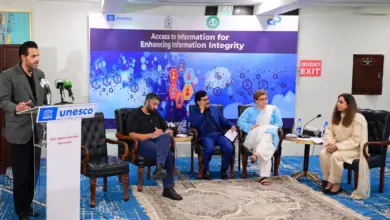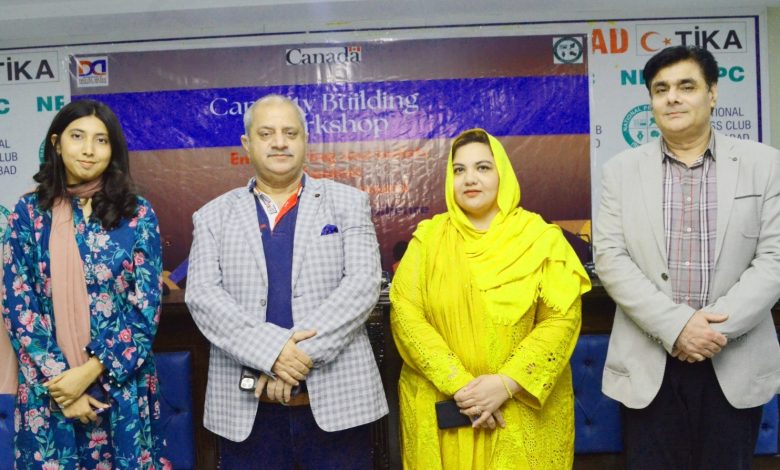
The National Press Club Islamabad, in collaboration with the Canadian High Commission and the Department of Digital Media at Punjab University, held a one-day training workshop to empower journalists against online harassment. Dozens of reporters from the twin cities attended sessions designed to build practical resilience, peer networks and rapid response capacities against digital threats.
NPC Secretary Naeer Ali opened the event, saying the club regularly organises programs to enhance members’ skills and professional welfare. The chairperson of the Department of Digital Media, Professor Dr. Suvira Majeeb Shami, briefed participants on the evolving risks journalists face. She noted Pakistan’s precarious position in the 2025 World Press Freedom Index, ranking 158 out of 180, and warned that digital, social and physical threats are directly undermining journalists’ safety and ability to report.
Speakers emphasised that the swift digitalisation of the media landscape brings both opportunities and dangers. Social platforms have expanded reach but also enabled coordinated trolling, disinformation and gendered abuse. Women reporters in particular have been disproportionately targeted through image manipulation, doxxing, stalking, character assassination and organised online hate campaigns that often spill into real-world threats.
While legal tools such as the Prevention of Electronic Crimes Act (PECA) and other regulatory frameworks exist, workshop presenters highlighted their limitations: slow processes, lack of transparency and narrow scope that frequently leave victims with little immediate protection. Weak institutional safety measures further increase the impact of online attacks.
Organisers argued that laws alone are not enough and promoted a multidimensional approach to digital safety that combines preventative, community-based and non-judicial interventions. The workshop stressed capacity building, peer support, digital hygiene training and mental health awareness as essential elements to strengthen resilience among media professionals.
A central goal presented at the workshop was the establishment of a sustainable Women’s Journalists Digital Safety Network (WJDSN) to act as a peer-led platform for knowledge sharing, rapid response and institutional solidarity. Participants were trained in technical, emotional and strategic measures so they can identify, prevent and respond effectively to digital security incidents within their organisations and professional networks.
Expected outcomes included improved institutional understanding of gendered online risks and security protocols among press clubs, media organisations and academic partners; activation of WJDSN as a practical peer-support mechanism; and a strengthened culture of safety inside newsrooms through greater confidence, reporting awareness and proactive digital security steps.
The workshop concluded with certificates presented to participants by PFUJ President Afzal Butt, signalling continued support from national bodies for initiatives that advance digital safety, media freedom and gender equity in Pakistan’s journalism community.