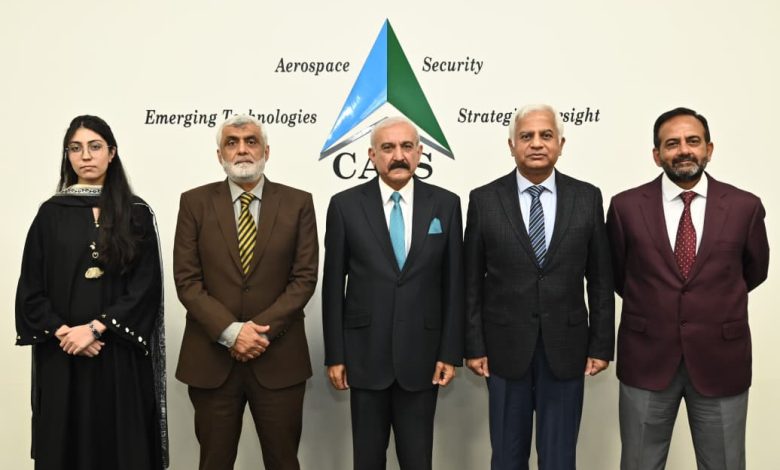
The Centre for Aerospace & Security Studies convened a high-level roundtable on 23rd October 2025 to examine the psychological and strategic layers of aerospace power and their implications for Pakistan and South Asia. Senior practitioners and scholars discussed how doctrine, leadership and emerging technologies are changing the calculus of air and space operations across the region.
Air Vice Marshal Nasser ul Haq Wyne (Retd), Director CASS, opened the session by underlining that modern aerospace power rests as much on doctrinal clarity and psychological readiness as on platforms and sensors. He argued that leadership, robust training and decision-loop compression determine outcomes when information cycles and perception shape battlefield effects.
Air Marshal Zulfiqar Ahmed Qureshi (Retd), President of the Centre for Character & Leadership Development at PAF Academy, expanded on how true advantage now lies in employment strategy, training and clear leadership. He highlighted that domains such as space, cyber, electronic warfare and artificial intelligence compress the OODA loop and enable faster, more decisive action, and he reiterated the Pakistan Air Force’s central role in securing citizens through cost-effective, decisive air effects.
Air Marshal Farooq Habib (Retd) explored the psychological mechanisms that shape public opinion and political decisions in contemporary conflict. He stressed resilience training for leaders who must operate under degraded, ambiguous and deceptive conditions and urged sustained public education to blunt adversary efforts at psychological dominance. He also advocated grounding senior leaders in the social sciences and institutionalising information operations expertise within air operations planning.
In closing remarks, Air Marshal Javaid Ahmed (Retd), President CASS, observed that as conflict extends into cyber, space and information domains the psychological component of deterrence becomes as important as technological strength. He affirmed CASS’s ongoing commitment to advance doctrinal thinking that blends intellect, innovation and resolve in support of Pakistan’s national security.
Participants agreed that integrating AI, space systems and electronic warfare into doctrine and training will reshape the balance of power across South Asia. Strengthening doctrines that link technological capability with leadership, decision-loop compression and public resilience was presented as essential to sustaining effective aerospace power and regional stability.