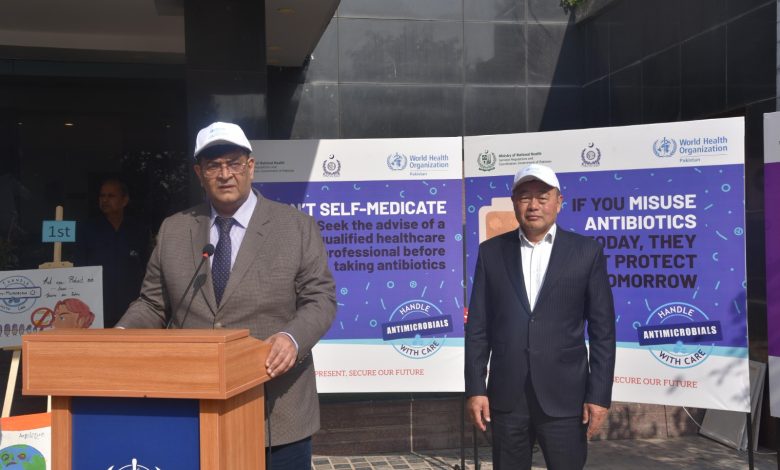
The National Institute of Health (NIH) and the World Health Organization (WHO) organised an Awareness Walk in Islamabad to mark the start of World Antimicrobial Resistance Awareness Week, observed from November 18 to 24. The walk brought together health experts, government officials, development partners, civil society and media to highlight the urgency of tackling Antimicrobial Resistance in Pakistan.
The 2025 global theme “Act Now: Protect Our Present, Secure Our Future” framed the event as a call to immediate, coordinated action. Participants used the occasion to stress that short-term measures and long-term policy shifts are both needed to slow the spread of resistant infections and protect public health.
Antimicrobial Resistance occurs when bacteria, viruses, fungi and parasites stop responding to medicines, making common infections harder or impossible to treat. The event described AMR as a silent pandemic that risks reversing decades of medical progress unless stronger surveillance, stewardship and infection prevention are implemented across sectors.
Dr. Muhammad Salman, CEO NIH, urged a comprehensive One Health response that recognises the links between human, animal and environmental health. He highlighted local drivers of resistance in Pakistan, including irrational prescribing, over-the-counter antibiotic sales, weak infection prevention and control in hospitals and communities, and misuse of antimicrobials in agriculture and livestock.
Dr. Luo Dapeng, WHO Representative in Pakistan, noted a significant milestone: Pakistan and WHO have launched the first national priority pathogen list in the Eastern Mediterranean Region, one of the first eight such lists worldwide. This national tool will guide surveillance, laboratory capacity and targeted interventions against priority resistant pathogens.
The Awareness Walk reinforced the core priorities of Pakistan’s National Action Plan on AMR, focusing on strengthening surveillance across human and animal sectors, improving public and professional awareness, and enforcing infection prevention and control in healthcare facilities. The NIH urged policymakers, healthcare providers, veterinarians, farmers and the public to translate commitments into practical measures that reduce misuse of antimicrobials and protect health systems for the future.