Shaping Policy through Evidence: Strengthening Systems for Children in Pakistan

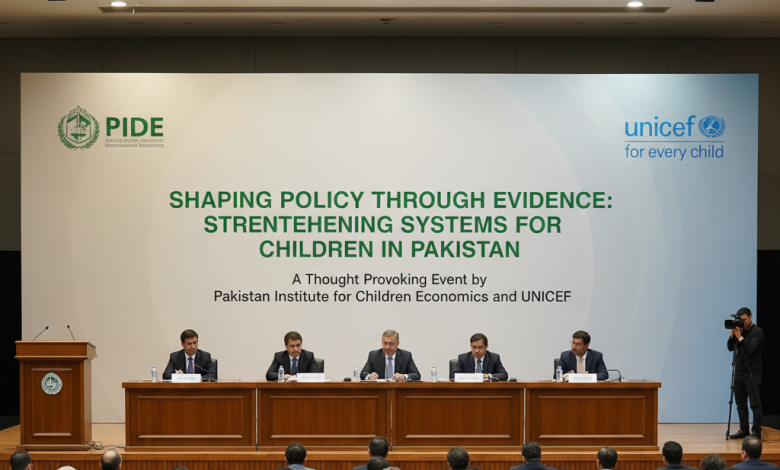
Shaping Policy through Evidence: Strengthening Systems for Children in Pakistan: A Thought Provoking Event by Pakistan Institute of Development Economics and UNICEF
Madeeha Gohar Qureshi
Research Economist,
Pakistan Institute of Development Economics
Pakistan Institute of Development Economics in collaboration with UNICEF in their jointly organized event on the theme Shaping Policy through Evidence: Strengthening Systems for Children in Pakistan dated 17th December, 2025 ignited debate on extremely important policy issue that is there shortage of research evidence on important social and developmental gaps in Pakistan or is there something more structural that needs identification.
In inaugural panel discussion, Dr Nadeem Javaid, Vice Chancellor (VC), Pakistan Institute of Development Economics (PIDE) not only highlight the dismal situation of children in Pakistan as is evident by huge proportion of out of school (26 million) and stunted children (40%), but also pointed out that Pakistan does not suffer from lack of policies or data, rather there exist a major crisis of right resource allocation and lack of action due short term policy visions and institutional inertia. In this perspective, in the worthy leadership of the Dr Nadeem Javaid, Vice Chancellor, PIDE and Dr Shujahaat Farooq, Dean Research, PIDE, Pakistan Institute of Development Economics along with UNICEF Pakistan brought forth a very important thought provoking fact that strengthening policy evidence use require strengthening system and institutions first that are a must for outcome delivery.
The important aspect of strengthening mechanism as identified within the initiated discourse was not just how the data sources can and should be improved, whether it be through better collection methods or through integrating of already produced data in more digitalized and interconnected way but to assure a fair, independent and accountable funding mechanism system in place. In this context, Dr Nadeem Javaid pointed to some very interesting facts that academic research shows that impact of economic reform comes most immediate with it taking on average 5 to 10 years to materialize and that of judicial reforms or constitutional amendments take a bit longer with average time frame of 10 to 15 years for former and 15 to 20 years for later. But in context of 18th amendment in Pakistan its already been 15 years, yet devolution to assure strengthening of delivery mechanism at local bodies is yet nowhere to be seen.
To understand why this is so, he pointed that one needs to understand the fundamental problem in social sector development in Pakistan. In context of lack of general awareness, he pointed to issue of low literacy level of population at large and the trap it creates for policy success at all fronts. But why these dynamics do not change in Pakistan is the real question that requires introspection at political economy front of the issue. Meaning that for any policy intervention to be become successful, it has to be made with a long term vision with knowing that policy will be implemented consistently. Hence when looked deeply with this lens, it is found the key problem with Pakistan is that governments have tended to focus on policy interventions that can deliver results within their tenure, one due to populous pressures for votes, second they are not sure whether their policies will be carried on in next regime. Hence if results of an intervention cannot come within that political regime, then that intervention eventually dies down.
How to change these dynamics, is the very essence of PIDE and UNICEF collaborated event under discussion. In this context to create tangible impact on social issues, Dr Nadeem Javaid reiterated need for a unified voice on all fronts on social developmental issues of significance so that pressure can be built for policy commitment for building the human resource of Pakistan rather than short term fixes of filling physical infrastructural gaps. For the breakage of the current the status quo of policy being focused on brick and mortar to move towards human development issues such as child development as taken up in current conference, agents of change have to be unified and not fragmented. And this requires all stakeholders whether it be think tanks like PIDE, donor institutes like UNICEF or Media group to work in coordination.
Building on this vision, Dr. Shujahaat Farooq, Dean Research PIDE, presented his work on building integrated systems for Early Childhood Development (ECD)highlighting not only the missing links in Pakistan but initiating a policy discourse as per suggestion of Prof Ahsan Iqbal, Federal Minister for Planning, Development and Special Initiatives, on how important it is to move towards a child welfare index at all levels, national, provincial and district level in all its dimensions such as education especially ECD, their health, harassment etc. Beside that this conference also explored the new financing solutions for expanded fiscal space for children such as blended and impact financing, role of adaptive social protection through integration of climatic risk analytics, gender sensitive targeting and inclusive digital system for better climate shock mitigation, along with evidence and innovation in youth skill development and employability.
The key takeaway from this joint event for audience at this event was that the real issue with adopting evidence wasn’t just technical rather it has been mostly institutional. The need is of generating systems that can not merely evaluate outcome but embed evidence upstream into policy design, budgeting and delivery mechanism along with in-built accountability frameworks that penalize the administrative machinery that do not integrate evidence in policy implementation.