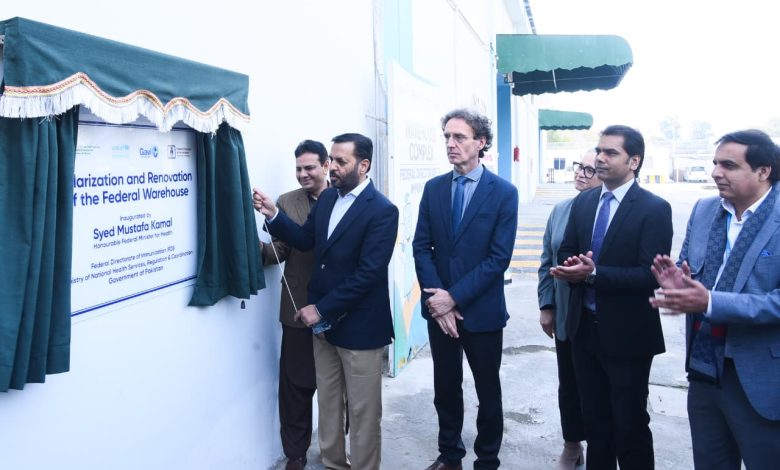
The Federal Health Minister, Syed Mustafa Kamal, inaugurated a 1 megawatt solar power installation at the EPI warehouse today in partnership with UNICEF, a step aimed at strengthening Pakistan’s vaccine cold chain and making immunization services more resilient during outages and emergencies.
The minister said the project underlines the government’s commitment to modern, sustainable healthcare infrastructure and to keeping lifesaving vaccines secure. “With the generation of 1 megawatt of electricity, vaccines will remain safe even in emergencies or power outages,” he added, stressing that an uninterrupted vaccine cold chain is essential to protect millions of children across the country.
Mustafa Kamal acknowledged operational support from Gavi and other international development partners, describing the solarization as an example of effective collaboration between the Government of Pakistan and its partners. UNICEF’s technical and logistical role was highlighted as central to bringing the project online.
The minister noted that Pakistan currently vaccinates against 13 diseases through its national programme, all provided free by the government, and that the HPV vaccine has been recently added to the schedule. He contrasted this with broader global coverage, pointing out that immunization programmes worldwide protect against up to 50 vaccine-preventable diseases and that some countries provide protection against more than 40 diseases.
On financing, the minister said Pakistan currently covers 49 percent of vaccine costs while 51 percent comes from global donors. He warned that donor support is expected to phase out by 2030, which would raise Pakistan’s vaccine bill from about USD 400 million to roughly USD 1.2 billion, a burden that will require strategic planning and sustainable investment to absorb.
Framing health as a matter of national security, Mustafa Kamal recalled the strain COVID-19 placed even on advanced systems and cited World Health Organization estimates that around 13 million Pakistanis were pushed below the poverty line by illness-related expenses. He reiterated that the government’s priority is shifting care from reactive sick care toward preventive health measures.
The minister also pointed to progress on access to treatment, saying 11,600 citizens from Islamabad, Azad Jammu & Kashmir and Gilgit-Baltistan have benefitted from the Universal Health Insurance scheme and that the Health Card initiative has been launched. Treatment capacity has been expanded to 13 additional hospitals to ease overcrowding at major facilities such as PIMS and Polyclinic.
Dr. Musa Khan, Director General FDI, called the warehouse solarization and renovation a transformative step for Pakistan’s immunization programme, saying continuous cold chain maintenance will keep vaccines potent regardless of challenges. Dr. Gunter Boussery, Chief of Health Section at UNICEF Pakistan, said UNICEF is proud to support sustainable solar energy solutions that safeguard vaccines and invest in the long-term health of children.
The 1MW solar installation at the EPI warehouse is presented by the government as both a technical upgrade and a policy signal that investment in the vaccine cold chain and sustainable infrastructure is central to protecting public health and preparing the system for the end of external vaccine financing.