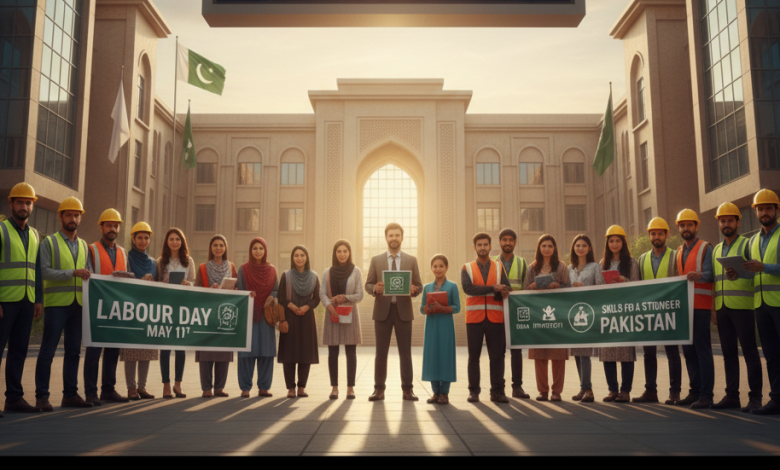
Labour Day in Pakistan and the Role of National Skills University
Professor Nadeem Iqbal
Labour Day, observed annually on May 1, is a significant public holiday in Pakistan dedicated to honouring the contributions of workers and the labour movement. Internationally known as International Workers’ Day, it commemorates the historic struggles of labourers for fair wages and better working conditions, particularly the 1886 Haymarket affair. In Pakistan, the day was officially recognised in 1972 under Prime Minister Zulfikar Ali Bhutto. Rallies, seminars, and awareness programmes are held nationwide to highlight workers’ rights, decent wages, occupational safety, and social security. It serves as a powerful reminder that the dignity of labour lies at the heart of national progress and social justice.
The significance of Labour Day becomes even more relevant amid current global challenges. A large portion of Pakistan’s workforce, especially in informal sectors, continues to face issues like low wages, job insecurity, and lack of proper skills. The day provides an opportunity for policymakers, academia, and industry to recommit to empowering workers through education, training, and protective policies. In today’s uncertain world, investing in human capital is not just a moral duty but an economic necessity for building resilience.
National Skills University (NSU) Islamabad plays a pivotal role in this transformation. As Pakistan’s first public sector university dedicated exclusively to skills development and technical & vocational education and training (TVET), NSU offers practical, industry-aligned programmes that prepare youth for real-world employment. By producing skilled graduates, the university bridges the gap between education and the job market, contributing directly to a more productive workforce.
Particularly noteworthy is the Department of Management Sciences at NSU, which equips students with modern business and leadership skills. The department offers programmes such as BBA, BS Business Analytics, BS Fintech & E-Commerce, and BS Hospitality & Tourism. These degrees combine theoretical knowledge with hands-on training, enabling graduates to manage organisations efficiently, foster innovation, and generate employment opportunities. By developing skilled managers and entrepreneurs, the Department of Management Sciences strengthens the connection between educated youth and the labour market, perfectly aligning with the true spirit of Labour Day.
In the current global context, the ongoing USA-Iran war that erupted in February 2026 has created serious economic challenges for Pakistan. The conflict, involving US and Israeli strikes on Iran followed by Iranian retaliation and a fragile ceasefire, has severely disrupted the Strait of Hormuz — a critical route for global oil supplies. As a result, international oil prices have surged sharply, increasing Pakistan’s weekly oil import bill dramatically. This situation has put extra pressure on the national economy, leading to higher inflation, energy shortages, and increased cost of living, which directly affects millions of Pakistani workers and labourers.
The USA-Iran conflict further highlights the urgent need for a skilled and resilient workforce in Pakistan. Disruptions in global energy markets and potential impacts on remittances and trade have made it clear that Pakistan must reduce its vulnerability through self-reliance. Institutions like National Skills University, particularly its Department of Management Sciences, are vital in this regard. By training professionals in areas such as business analytics, fintech, supply chain management, and tourism, NSU can help develop a workforce capable of navigating economic shocks, improving productivity, and supporting export-oriented growth even in turbulent times.
Labour Day in Pakistan is not only a celebration of workers’ contributions but also a call to strengthen their capabilities through quality skills education. Amid the economic uncertainties caused by the USA-Iran war, the role of the National Skills University Islamabad and its Department of Management Sciences becomes even more critical. By producing skilled human capital, these institutions honour the spirit of Labour Day while contributing to a stronger, more self-reliant Pakistan. Investing in skills development today will ensure that Pakistani workers can face future challenges with dignity and competence.