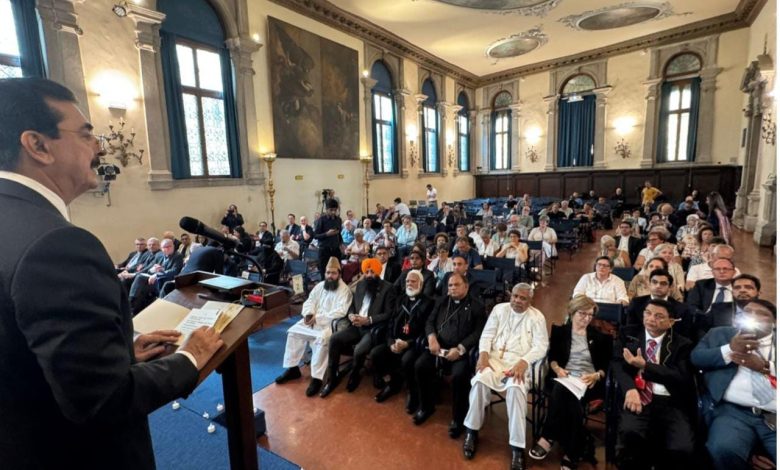
Pakistan Senate Chairman Syed Yousaf Raza Gilani emphasized the importance of justice, dialogue, and human dignity as essential elements for achieving lasting global peace during a major international peace conference in Venice. Addressing esteemed delegates from Europe and Pakistan, Gilani called for renewed international commitment grounded in moral clarity, drawing attention to unresolved conflicts and citing Pakistan’s own experiences as cautionary examples of the devastating human toll exacted by violence and instability.
The international gathering, titled “The Challenges to World Peace Today,” brought together prominent religious, political, and academic figures from Europe and Pakistan. Distinguished participants included the Archbishops of Venice, Treviso, Vicenza, and Piacenza, as well as members of Parliament, civic authorities, and representatives of international peace organizations and advocacy groups. The event, co-convened by renowned peace advocate Dr. Paul Bhatti, sought to foster meaningful dialogue and spur decisive global action amidst rising geopolitical tensions and increasing intolerance worldwide.
In his keynote speech, Chairman Gilani honored Shahbaz Bhatti, Pakistan’s former Federal Minister for Minorities Affairs, who was assassinated for advocating tolerance and minority rights. Gilani hailed Bhatti as a courageous figure of international stature whose martyrdom “was not just Pakistan’s loss but a blow to the global conscience.” He connected Bhatti’s legacy to the broader vision of the Pakistan People’s Party (PPP), underscoring the party’s enduring dedication to justice, diversity, and equal rights.
Highlighting troubling geopolitical developments from South Asia and the Middle East to Eastern Europe, Senator Gilani warned of the grave implications of ongoing conflicts. He argued strongly that peace must be understood as more than merely avoiding war: “Peace is not merely the absence of war—it is the presence of justice and the celebration of diversity,” he affirmed, highlighting the need for inclusive approaches to international relations.
Sharing Pakistan’s painful experiences firsthand, Gilani highlighted his personal ordeal when the Taliban kidnapped his son, emphasizing how deeply terrorism and instability affect not only nations but also families and individuals. He reminded world powers of the importance of reciprocal goodwill in diplomatic dealings, specifically referencing the longstanding Kashmir conflict. He urged international actors to approach disputes from a perspective guided primarily by justice and moral clarity, rather than narrow strategic interests.
Concluding his impactful remarks, Gilani issued a stirring call to action to global leadership. He appealed to governments, international institutions, and communities worldwide, urging them to turn commitments declared during the Venice conference into meaningful and sustained action. “Let this gathering in Venice be remembered not just as another conference, but as a collective vow—a vow to lead, to act, and to protect peace not as an ideal, but as a necessity,” Gilani passionately affirmed.
The high-level event represented another significant milestone in Pakistan’s ongoing advocacy for interfaith harmony, international cooperation, and durable global peace.