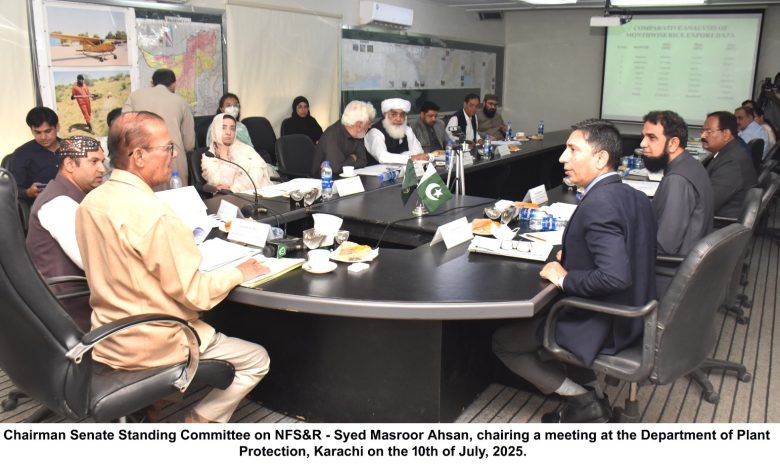
Pakistan has significantly reduced agricultural export interceptions through decisive reforms prompted by Prime Minister Shahbaz Sharif, achieving notable improvements in food safety compliance and phytosanitary standards. These developments were highlighted during a visit by the Senate Standing Committee on National Food Security and Research, chaired by Senator Syed Masroor Ahsan, to the Department of Plant Protection (DPP) in Karachi, to review measures for enforcement of international sanitary and phytosanitary (SPS) guidelines and actions to reduce violations regarding Maximum Residue Limits (MRLs).
Senior officials of DPP, including Director General Mr. Tahir Abbas, Deputy Director Quarantine Dr. Muhammad Ishfaque, and Director Quarantine Mr. Muhammad Basit, provided a comprehensive briefing on corrective actions implemented in response to clear directives from Prime Minister Shahbaz Sharif. These instructions, originally issued in December 2024, mandated strict legal actions against negligent officers and underscored the immediate establishment of pesticide residue testing laboratories.
As a result of these targeted interventions, Pakistan’s once problematic rice exports have recorded substantial improvement. The country, which experienced a concerning rise in rice consignment interceptions by the European Union—from 61 incidents in 2023 to 106 in 2024 (with 73 related specifically to pesticide residues)—now sees a welcome turnaround. The number of interceptions in 2025 has significantly declined to only 30, with just 13 involving pesticide residues and 15 connected to aflatoxins. This success was largely attributed to enhanced monitoring, exporter awareness initiatives, and improved coordination involving the DPP, provincial authorities, and industry stakeholders. The pesticides Acetamiprid, Chlorpyrifos, Imidacloprid, and Thiamethoxam were identified as primary reasons for earlier MRL breaches.
The committee also addressed challenges in the maize sector, another important agricultural export for Pakistan. Annual maize production stands at 10.634 million tons cultivated on 1.72 million hectares. Maize exports peaked at approximately 1.837 million metric tons during the 2023–24 period but witnessed a sharp reduction to about 786,000 metric tons in 2024–25. This decline, attributed partly to domestic price fluctuations, was further exacerbated by repeated phytosanitary interceptions from Vietnam due to infestations of khapra beetles (*Trogoderma granarium*). Following Vietnam’s third warning, along with 72 reported interception events, DPP enforced a temporary two-week export suspension and took disciplinary actions against accountable fumigators. Corrective measures included registering 63 compliant storage godowns, introducing stringent traceability protocols, and establishing pest-specific fumigation standard operating procedures (SOPs). Additional steps focus on stakeholder coordination, intensified inspection routines, and strict regulation over jute bags—a proven infestation source.
Turning attention to mango exports, the committee raised concerns regarding operational irregularities affecting high-value markets in Japan, Korea, and the United States. These markets stipulate strict treatment protocols, including hot water treatment (HWT) and vapor heat treatment. Despite DPP’s establishment of SOPs and installation of CCTV surveillance systems for these procedures, allegations surfaced regarding equipment malfunction, non-operational surveillance, and corruption—such as officials reportedly receiving payments per kilogram to circumvent essential treatments. One prominent exporter reported a drastic reduction in mango exports—from a previous level of 40,000 kilograms down to just 7,000 kilograms this season—as a result of inconsistent enforcement and preferential behaviour among inspection officials.
In response to these concerns, the committee reinforced the importance of appointing a technically qualified and permanent Director General for DPP, preferably with a PhD or advanced education in entomology or plant protection. According to Chairman Senator Ahsan, filling this vital position with an experienced professional would bolster strategic oversight and enhance the department’s capabilities significantly.
Furthermore, the committee reiterated strong support for establishing the proposed National Food Safety, Animal, and Plant Health Regulatory Authority (NAFSA), releasing funds for new laboratory facilities, and revising fumigation regulations to better match current export demands. Initiatives such as capacity-building workshops, outreach programs for farmers, and improved provincial coordination were recognized positively.
Concluding the session, Senator Masroor Ahsan applauded the progress achieved due to the Prime Minister’s reform roadmap and stressed the necessity for ongoing political commitment, institutional transparency, and technical leadership. While significant reductions in export interceptions are encouraging, sustained vigilance and collaborative effort are essential to restoring international confidence in Pakistani agricultural produce.
The meeting was attended by Senators Rahat Jamali, Dost Muhammad Khan, and Abdul Wasay. However, the committee noted with regret the absence of officials from the Ministry of National Food Security and Research, expressing disappointment and instructing that a letter be issued to the Chairman Senate, requesting appropriate repercussions and stressing the Ministry’s obligation to fully engage in critical national matters.