PESHAWAR: The Khyber Pakhtunkhwa government has instructed all public sector universities in the province to continue admissions to computing programmes, taking the position that any halt at this stage could harm students, disrupt university planning and affect the future stability of public institutions.
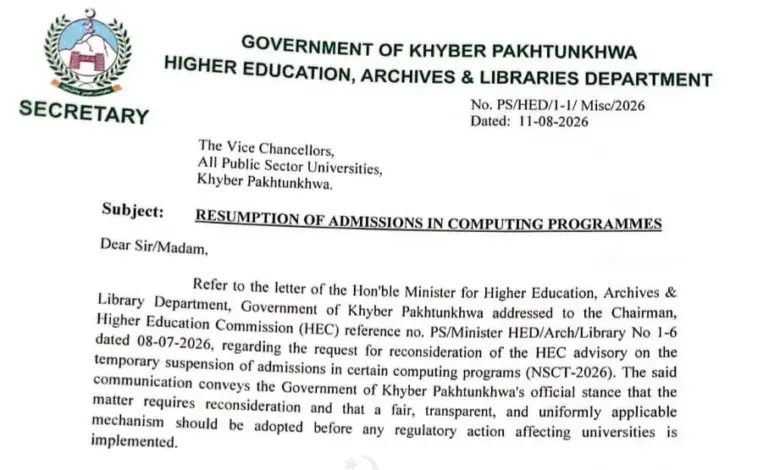
The directives were issued by the Higher Education, Archives and Libraries Department to the vice chancellors of all public sector universities across Khyber Pakhtunkhwa.
The move follows an advisory from the Higher Education Commission (HEC), which had suggested a temporary suspension of admissions in certain computing programmes under the National Skills and Competency Test (NSCT) 2026.
In its letter, the provincial higher education department said the KP government had asked the HEC to review its advisory. It maintained that any regulatory measure affecting universities should be applied through a fair, transparent and uniform mechanism.
The department stated that the provincial government did not support stopping admissions in the affected computing programmes at the present stage.
It cautioned that suspending admissions could create difficulties for students intending to pursue computing education, besides disturbing academic planning and weakening the long-term stability of universities.
Public sector universities have, therefore, been directed to carry on with the admission process for the relevant computing programmes during the current admission cycle, in line with the approved admission schedule and existing rules.
The letter further said that universities should continue admissions until fresh instructions are issued by the competent authority.
According to the provincial government, the decision has been taken to safeguard the academic interests of students, retain public confidence in the higher education system and avoid any adverse impact on student enrolment and the reputation of universities.
The development is significant for thousands of students seeking admission to computing-related programmes in public sector universities of Khyber Pakhtunkhwa, as the provincial authorities have made it clear that the admission process should not be stopped at this stage.