Article by: Izmi Herlani
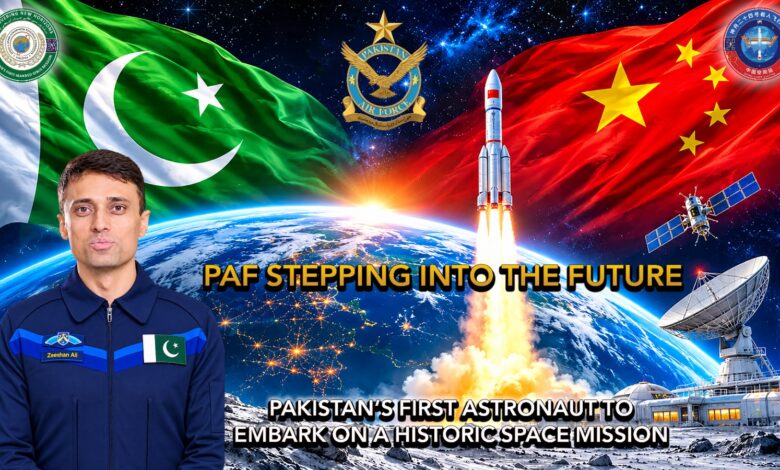
A Pakistani falcon conquers a new frontier — from defending the nation's skies to carrying its dreams beyond the stars. There are moments when a nation's pride seems to rise beyond the limits of geography. On 25 November 2026, as Wing Commander Muhammad Zeeshan Ali stepped aboard China's Tiangong Space Station, Pakistan witnessed such a moment. A son of its soil, an accomplished Pakistan Air Force fighter pilot, had crossed a frontier few ever reach. He was the first Pakistani to enter Earth's orbit and the first foreign astronaut to board Tiangong. For millions watching, it was more than a spaceflight. It was the sight of a Pakistani flag entering a new domain of possibility.
Pakistan Air Force has built its reputation on a distinctive ethos: discipline, courage, professional mastery, intellectual curiosity and a resolve to turn challenges into opportunities. Its fighter pilots are shaped by demanding training, constant evaluation, with preparation as the foundation of confidence. They learn to make critical decisions in seconds, trust their teams and remain composed when the margin for error is almost zero. Those habits do not end at the edge of the atmosphere. The qualities demanded of a fighter pilot—precision under pressure, rapid judgement, technical fluency, teamwork and composure in uncertainty—are equally indispensable in space. Wg Cdr Zeeshan carried that training with him. His achievement reflects an institution that prepares its people for tomorrow's challenges. Under the leadership of Air Chief Marshal Zaheer Ahmed Baber Sidhu, PAF has placed renewed emphasis on modernization, technological self-reliance and the changing character of warfare. His strategic outlook recognises that air power can no longer be understood in isolation: cyber, electronic warfare, information networks, artificial intelligence and space-based capabilities increasingly shape the battlespace. The May 2025 conflict offered a sharp reminder of that reality. The contest was not confined to aircraft and missiles; it also unfolded across electronic and information domains. The world witnessed that PAF's offensive space capabilities disrupted Indian military satellite-linked systems. The strategic lesson is clear: future conflicts will be decided not only by what flies, but also by what can sense, connect, protect, disrupt and operate across multiple domains. Space is now consequential to national security.
Against this backdrop, Wg Cdr Zeeshan's selection for the Shenzhou-24 mission carries significance well beyond the symbolism of a launch. Selected under the Pakistan-China human-spaceflight cooperation programme, he undertook seven months of intensive preparation in China. Training covered spacecraft and station systems, specialised operations, scientific payloads, emergency response, crew coordination and malfunction procedures. In space, every checklist and decision must be mastered before the moment arrives. There was another demanding frontier: language. Zeeshan immersed himself in Mandarin, learning mission-related commands and technical vocabulary so he could communicate clearly with Chinese crewmates. He also embraced the culture around him, learning Chinese songs and poetry and practising calligraphy. It was practical preparation for teamwork and safe operations, where communication can be as vital as technology.
At his press interaction before launch, Wg Cdr Zeeshan spoke in Chinese about the enduring friendship between Pakistan and China. He read Chinese poetry and described the mission not as an individual triumph but as a journey representing 250 million Pakistanis. His words bridged two nations and gave the occasion its emotional centre. Then came the moment that will live in Pakistan's national memory. After Shenzhou-24 docked with Tiangong, Zeeshan stepped inside the station as its first foreign astronaut. He recited Allama Muhammad Iqbal's immortal verse: "Sitaron se aagay jahan aur bhi hain." Iqbal's Shaheen, forever restless and unwilling to accept the limits of the familiar sky, had found a new expression in a Pakistani air warrior orbiting Earth.
The mission is also a beginning, not a finish line. It demonstrates what becomes possible when national institutions, scientific talent and international partnerships converge around a long-term ambition. As a payload specialist, Wg Cdr Zeeshan is participating in joint scientific work, including experiments in biotechnology and materials science. This work can strengthen Pakistan's research ecosystem and inspire young people towards science and innovation. The challenge now is to turn this moment into sustained capability through education, research, indigenous technology and cooperation.
A fighter pilot is trained to protect the skies above his homeland. An astronaut reminds us that those skies are only the beginning. Wg Cdr Zeeshan Ali has carried the discipline of PAF, the warmth of Pakistan-China friendship and the hopes of a nation into orbit. His journey tells every child looking up at the night sky that ambition need not stop at the horizon. Pakistan's falcon has flown higher than ever before. The stars are no longer just distant points of light; they are invitations. And this time, Pakistan has answered.