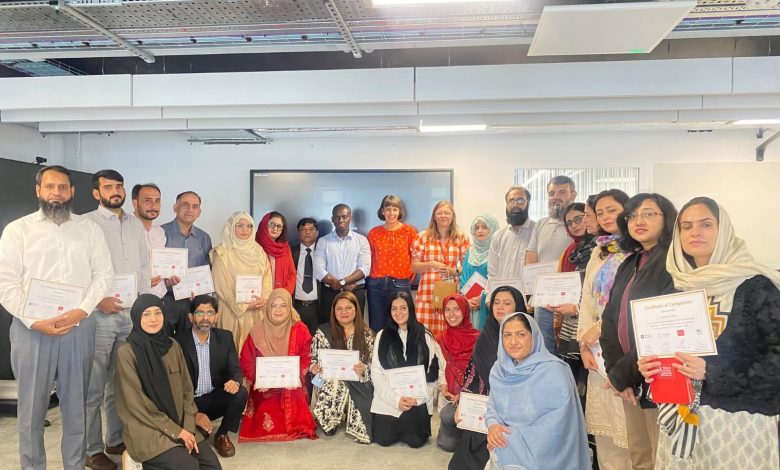
Dr. Bushra Parveen, a faculty member from the Department of Physics at Rawalpindi Women University, has completed an intensive technical training program in the United Kingdom aimed at enhancing STEM education through project-based learning. The week-long program was held across multiple prestigious venues including the National STEM Learning Centre at the University of York, the University of Birmingham, and King’s College London.
The training was conducted under a “train-the-trainer” approach, designed to enable participants to transfer knowledge and innovative teaching methods to their home institutions. Core areas of focus included the implementation of modern teaching strategies in STEM fields, the integration of project-based learning into curricula, and building stronger connections between academic study and industry through work-integrated learning.
Participants also explored effective assessment techniques and rubric design, aimed at improving the measurement of student learning outcomes. In addition, the program highlighted the importance of developing communities of practice and establishing networks of STEM ambassadors to further promote science and technology disciplines among students.
Dr. Parveen’s participation is expected to contribute to the ongoing advancement of teaching methodologies at Rawalpindi Women University, particularly in the fields of science, technology, engineering, and mathematics.