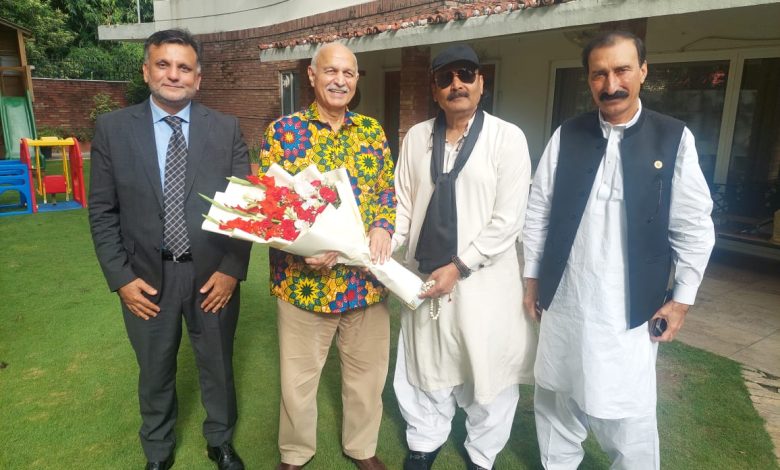
Federal Minister and Chairman of the Parliamentary Committee on Kashmir, Rana Muhammad Qasim Noon, and Chairman of the Standing Committee on Defence, Fateh Ullah Khan, held a meeting with Senator Mushahid Hussain Syed to discuss Pakistan’s relations with China and the strategic situation in South Asia, with a special focus on the Kashmir dispute and growing regional tensions.
The discussions centered on the increasingly influential roles played by China, Iran, and Israel in shaping South Asia’s security landscape. Rana Muhammad Qasim Noon highlighted Pakistan’s longstanding alliance with China, particularly praising Beijing’s steadfast support for Pakistan on the Kashmir issue. He emphasized that, since May, the region’s balance of power had shifted significantly, elevating the Kashmir conflict from a regional dispute to an international concern. Citing severe human rights violations in Indian-administered Jammu and Kashmir, Noon called attention to the ongoing imprisonment and denied rights of prominent Kashmiri leaders. He insisted that enduring peace in South Asia hinges on a just solution to the Kashmir question in line with United Nations resolutions.
Noon also recognized the efforts of Pakistan’s armed forces, particularly the Pakistan Air Force, during the events of 10 May, and drew attention to the interconnectedness of the Kashmir issue, the Indus Waters Treaty, and allegations of Indian-backed terrorism in the region. He condemned India’s actions in Balochistan and Khyber Pakhtunkhwa and noted Pakistan’s substantial economic losses due to the fight against terrorism. Reflecting on a recent armed conflict with India, he stated that Pakistan’s civil and military leadership had effectively countered Indian aggression, and argued that India now faces diplomatic and political isolation as a result of its policies.
In a joint statement, Rana Muhammad Qasim Noon and Senator Mushahid Hussain Syed welcomed recent remarks by Chinese Foreign Minister Wang Yi, who commended the Pakistan Army’s role in nurturing the Pakistan–China relationship. They underscored the importance of China’s diplomatic backing on the Kashmir issue and reaffirmed Pakistan’s commitment to protecting Chinese interests, deepening counterterrorism cooperation, and strengthening the strategic partnership between the two countries.
Senator Mushahid Hussain Syed added that the Kashmir conflict is critical to global stability and advocated for a more proactive Pakistani foreign policy, particularly in light of evolving regional dynamics involving China, Iran, and Israel. He also highlighted that an earlier offer of mediation on Kashmir by the President of the United States was a constructive step that should have received more attention.
Fateh Ullah Khan underlined that Kashmir is central to Pakistan’s national security and regional peace. He reaffirmed the nation’s pride in its deep ties with China and its resolve to maintain partnerships with countries that recognize Pakistan’s sovereignty and support the Kashmiri people’s struggle for self-determination.