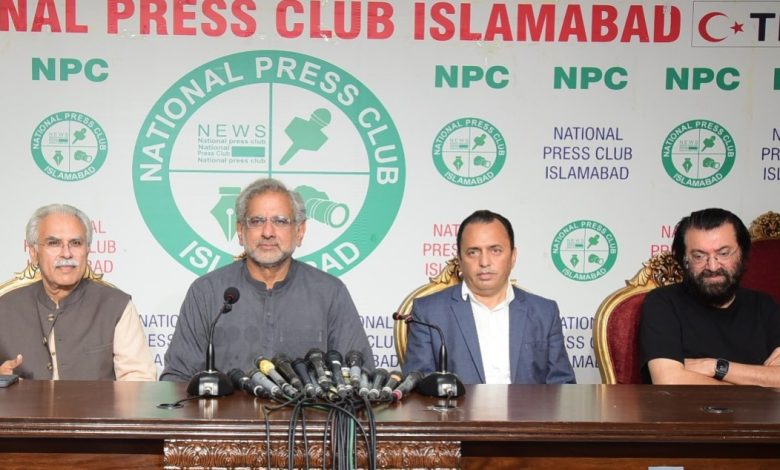
Former Prime Minister and Convener of the Awam Pakistan Party, Shahid Khaqan Abbasi, has criticized the government for policies that have resulted in soaring sugar prices and alleged significant financial benefits for sugar mill owners at the expense of ordinary citizens. Abbasi claimed that the government’s actions have not only failed to protect public interests but have also deepened economic challenges for the people.
Speaking at a press conference at the National Press Club in Islamabad, Abbasi accused the government of purchasing sugar at prices higher than those in the international market and then failing to make that imported sugar available to the public. He alleged this allowed sugar mill owners to profit massively, as the hike in sugar prices transferred an estimated 300 to 400 billion rupees from consumers directly to the owners. He further claimed that beverage companies and other factories were compelled to purchase sugar at inflated prices, benefiting the industry while disadvantaging ordinary people.
Abbasi pointed out that despite the existence of at least seven or eight committees, including a cabinet-level sugar monitoring committee, tasked with controlling sugar prices, these bodies have been unable to prevent a 50 percent increase in sugar prices over the past year. He stated that for every rupee increase in the price of sugar, about seven billion rupees are extracted from the public’s pockets.
He also criticized government decisions to permit sugar exports even when domestic supplies were insufficient, and accused authorities of granting further relief to sugar mill owners during the import process. Abbasi said that even now, an estimated one billion rupees is being transferred daily from consumers to sugar producers, and described the country’s governance as ineffective in tackling price inflation not just in sugar, but also in basic goods like flour.
Abbasi highlighted that sales tax exemptions provided by the government failed to benefit consumers, as imported sugar was withheld from the market and instead sold to industrial buyers at high prices. He argued that no retailer can afford to sell sugar at a loss, which has led to scarcity in the market. He called for authorities to acknowledge mistakes in handling the sugar crisis and take responsibility for the continuing difficulties faced by the nation’s population.