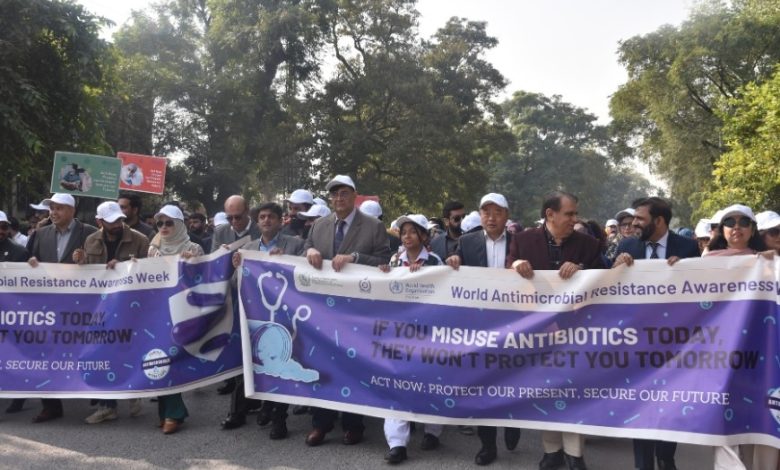
The National Institute of Health and the World Health Organization launched Pakistan’s first National Priority Pathogen list for antimicrobial resistance during an Antimicrobial Resistance Awareness Walk in Islamabad to mark World Antimicrobial Awareness Week. The list, announced as the first for WHO’s Eastern Mediterranean Region and among the first eight pathogen lists globally, aims to guide national action against rising antimicrobial resistance and strengthen preparedness across human, animal and environmental health sectors.
Pakistan faces a heavy burden from antimicrobial resistance: every year there are over 200,000 directly attributable and associated deaths linked to resistant infections. Without urgent measures, projections indicate this could rise to roughly 63,000 directly attributable deaths and 262,000 associated deaths by 2050 in Pakistan. Globally, antimicrobial resistance threatens up to 10 million deaths annually and a cumulative economic loss of $100 trillion by mid century if left unchecked.
Dr Muhammad Salman, CEO of the NIH, said: “Combating antimicrobial resistance requires a comprehensive One Health approach that addresses the interconnectedness of human, animal and environmental health.” He highlighted local drivers of resistance including irrational prescribing, over‑the‑counter sales of antibiotics, weak infection prevention and control practices, and the misuse of antimicrobials in agriculture and livestock.
Dr Luo Dapeng, WHO Representative in Pakistan, urged immediate action: “Antimicrobial resistance is not a distant problem. It is happening now. As we speak, every 5 minutes, 2 people die due to antimicrobial resistance or associated reasons in Pakistan. These deaths are preventable.” The awareness walk and the National Priority Pathogen list were organised to mobilise communities and decision makers around the World Antimicrobial Awareness Week theme Act Now: Protect Our Present, Secure Our Future.
As part of the launch, NIH and WHO awarded winners of a student poster competition that used art to explain the importance of responsible antibiotic use. Children’s designs underlined how everyday choices—by families, health workers and farmers—can slow the spread of resistant infections and protect future generations.
The National Priority Pathogen list is presented as a milestone for Pakistan’s response to antimicrobial resistance, intended to guide surveillance, stewardship and policy across sectors. Stakeholders are being called upon to translate the list into stronger regulation of antibiotic sales, improved infection prevention and control in health facilities, and coordinated One Health interventions to reduce misuse in agriculture and livestock while protecting public health and livelihoods.