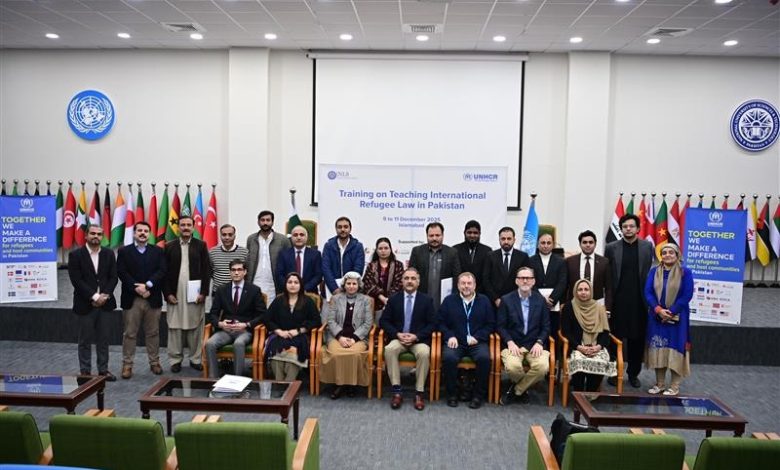
Over three days UNHCR, in partnership with NUST and several academic institutions, brought together law professors from across Pakistan for an intensive workshop on refugee law and migration. The programme focused on updating teaching practice and deepening faculty knowledge of refugee law.
Participants reviewed foundational concepts including non-refoulement and the 1951 Refugee Convention, and explored the rights of refugees within both international and Pakistan’s historical context. Sessions combined legal refreshers with practical classroom approaches to ensure refugee law is taught with current, real-world relevance.
The workshop delivered practical insights into actual refugee claims and modelled up-to-date teaching methodologies such as case-based instruction and participatory exercises. Faculty were supported to translate these methods into course content, assessments and student engagement strategies to better prepare future lawyers.
Concluding discussions mapped forward-looking steps to strengthen collaboration between law schools, define clear methods of engagement for legal support to refugees, and commit to innovative training that builds sustainable capacity in refugee law education.
Organisers expressed gratitude to participating academics and institutions and noted that the International Refugee Law training was supported by Canada, Denmark, the European Union, Germany and the Netherlands.
UNHCR and NUST said they will continue to advance refugee law teaching across Pakistan so the next generation of lawyers can effectively uphold refugee rights.