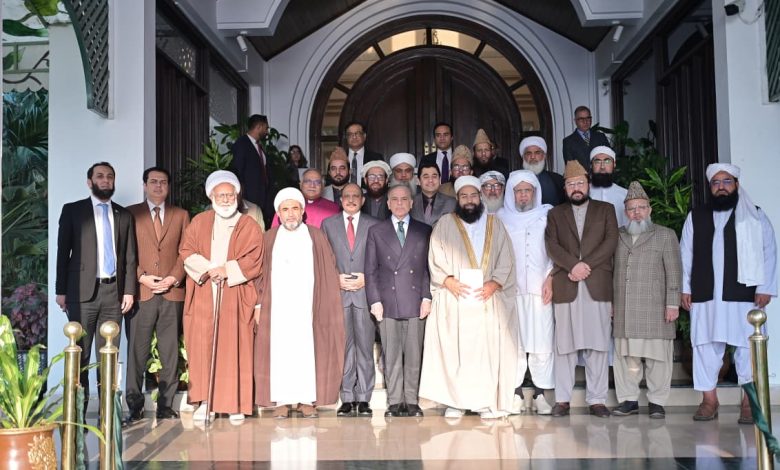
Prime Minister Shahbaz Sharif met members of the National Peace Committee and reiterated his commitment to eliminate poverty, reduce unemployment, secure debt relief and uproot terrorism from the country. He stressed the urgent need for national unity and said the state will use every available resource to restore stability, pledging that terrorism would be removed from Pakistan’s borders and “drowned in the Indian Ocean” as part of a comprehensive counterterrorism push.
The Prime Minister welcomed the inclusive composition of the Peace Committee, noting the participation of religious scholars from all schools of thought, minority representatives and civil society figures. He cited contributions from diverse leaders including veterans such as Cecil Chaudhry and former Supreme Court judge Rana Bhagwandas as examples of shared commitment to Pakistan’s development and social cohesion.
Shahbaz Sharif said Pakistan is endowed with vast natural resources and that proper use of these assets can solve many national problems. He outlined an ambition to convert the country into a true welfare state by pursuing debt relief, tackling poverty and creating jobs, while adopting methods aligned with the founding purpose of Pakistan.
The Prime Minister also referenced what he described as a decisive military achievement in May 2025, attributing success to the armed forces’ training, technology and the support of 240 million citizens. He framed these events as part of the broader determination to secure the nation and credited the military, police, rangers and other security agencies for sacrifices in the fight against militancy.
Highlighting the human cost of militancy, he recalled that around one hundred thousand Pakistanis — civilians and security personnel alike — lost their lives in the battle against terrorism. He warned that a resurgence led by groups he identified as Khawarij, TTP and TTA, supported by hostile actors, must be confronted decisively. The Prime Minister expressed confidence that, as in 2018, terrorism would again be crushed.
Committee convener Maulana Tahir Ashrafi and members outlined plans for broad outreach, including a two-day conference of scholars in Khyber Pakhtunkhwa, provincial visits by committee members, and close engagement with security forces to strengthen the narrative against extremism. The Peace Committee will also work to bring the message of interfaith harmony and tolerance to local communities through sustained dialogue and consultation.
Officials highlighted efforts to modernize religious education, noting that some 36,000 registered madrasas now offer both religious instruction and contemporary subjects alongside vocational training to improve graduates’ employment prospects. Authorities said teacher training is being upgraded and rejected claims that core religious curricula are being undermined.
Leaders from minority communities affirmed their support for national unity and the armed forces. Hindu representative Rajesh Kumar and Bishop Azad Marshall publicly pledged to stand with the state to promote tolerance, protect religious freedoms and contribute to Pakistan’s security and prosperity. Religious and civic leaders pledged to support the Peace Committee in countering extremist narratives and fostering social cohesion.
The government and the Peace Committee signalled a coordinated approach combining security measures, inclusive dialogue and educational reforms to confront ideological and violent extremism. The Prime Minister urged patience, wisdom and joint decision making as the committee advances its work to strengthen national unity and safeguard Pakistan’s future.